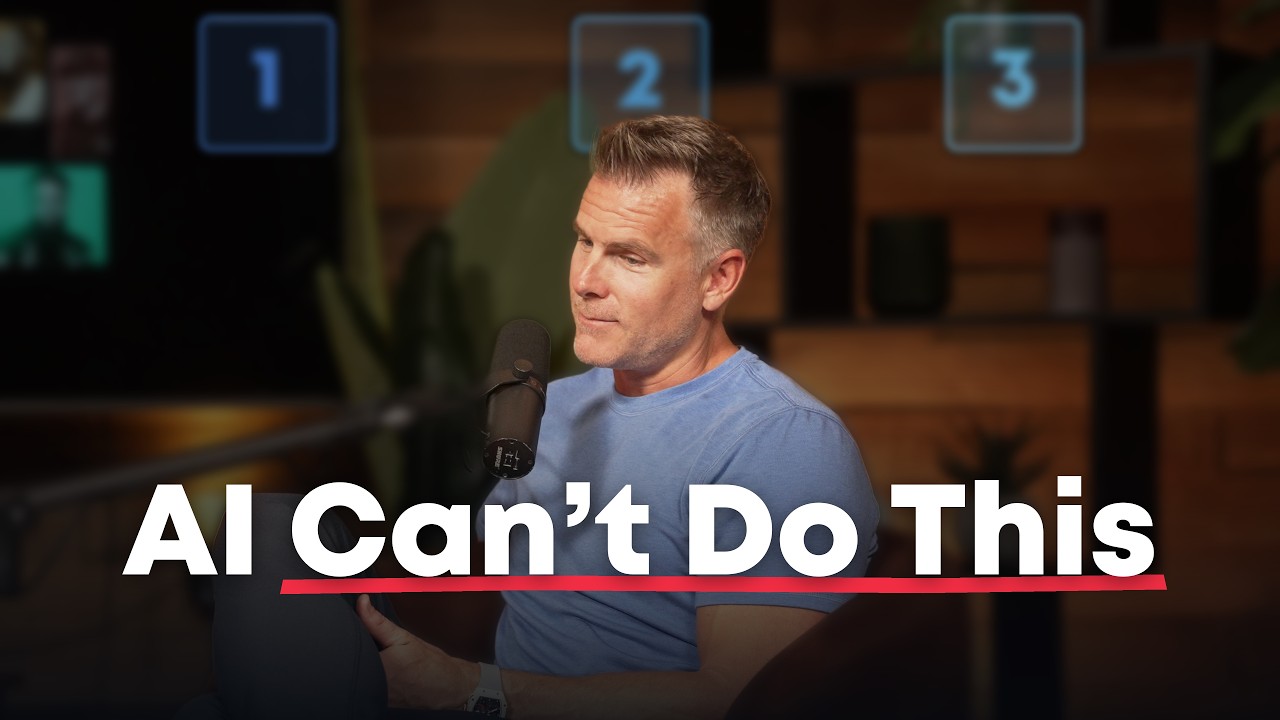
Dan Martell opens with a provocation most people are not ready to hear: look at what someone does on weekends, and you will know exactly how disrupted their working life is about to become. The people who spend weekends escaping their week, he argues, are the same ones who will be blindsided by AI. Everyone else, those who understand how to work alongside it, will live a completely different life. Martell has spent years coaching founders through chaotic growth, and his shorthand for what survives the AI wave is three letters: TVC.
Taste is harder to build than any prompt library
The first letter stands for taste, and Martell is deliberate about separating it from talent or technical skill. AI, he explains, is ‘essentially a fancy autocomplete,’ predicting words through tokens and math, drawing only on what the human species has already created. It cannot look at something and feel that there is something there. Taste is exactly that: the human ability to register quality before you can articulate why. He points to what music producers do, what Rick Rubin does, what a great chef does. It is a vibe, a feeling, a trained instinct that tells you the lighting is wrong or the sound is almost right.
The good news is that taste is buildable. Martell’s prescription is exposure: consume a large volume of world-class work in whatever domain matters to you, from food to software to music, and your internal standard rises with it.
Vision means seeing what should exist, not just what could
The V is vision, and Martell is careful to strip the mysticism out of it. Vision is not pretending to see the future. It is having clarity about a future that does not yet exist but should. That second qualifier is the one that trips people. He cites a wave of plant-based burger companies whose founders had genuine conviction but whose stock eventually fell 90 percent because the world, it turned out, did not actually want that product at that scale. Vision without the ‘should’ is just wishful thinking.
To land the idea of why vision is irreplaceable, Martell offers the kind of observation that stops a conversation cold: ‘Everything you see in this room was first conceived in the mind of a person from the past. All of it. So technically, we’re living in the dreams of the people from the past.’ AI amplifies the speed at which those dreams become real. It does not originate them.
The final letter is C, and Martell frames it as the one AI genuinely cannot simulate. Care is emotional intelligence: the specific human act of making someone else’s needs your own. He distinguishes between three types of intelligence: the analytical, where AI is already PhD-level; the creative, which is taste and vision combined; and the emotional. That third category, the felt sense that someone actually cares about you, is what binds teams, builds trust, and makes leaders worth following.
The moment care enters the room
Martell describes it in the plainest terms possible: ‘When we met, there’s a feeling. I feel you. I get you.’ A team member does not just need a manager who performs concern. They need to believe the concern is real. That belief cannot be generated by a model.
The practical summary he leaves with founders is blunt: yes, learn the technical side of AI, learn how to use it to generate revenue. But the long-term defensible position is the combination of taste, vision, and care. Those three things are what make someone difficult to replace, regardless of what the next model can do.
Martell leans forward at the end of the conversation, unprompted, and says he wants people to build something real, not just scroll toward someone else’s empire.