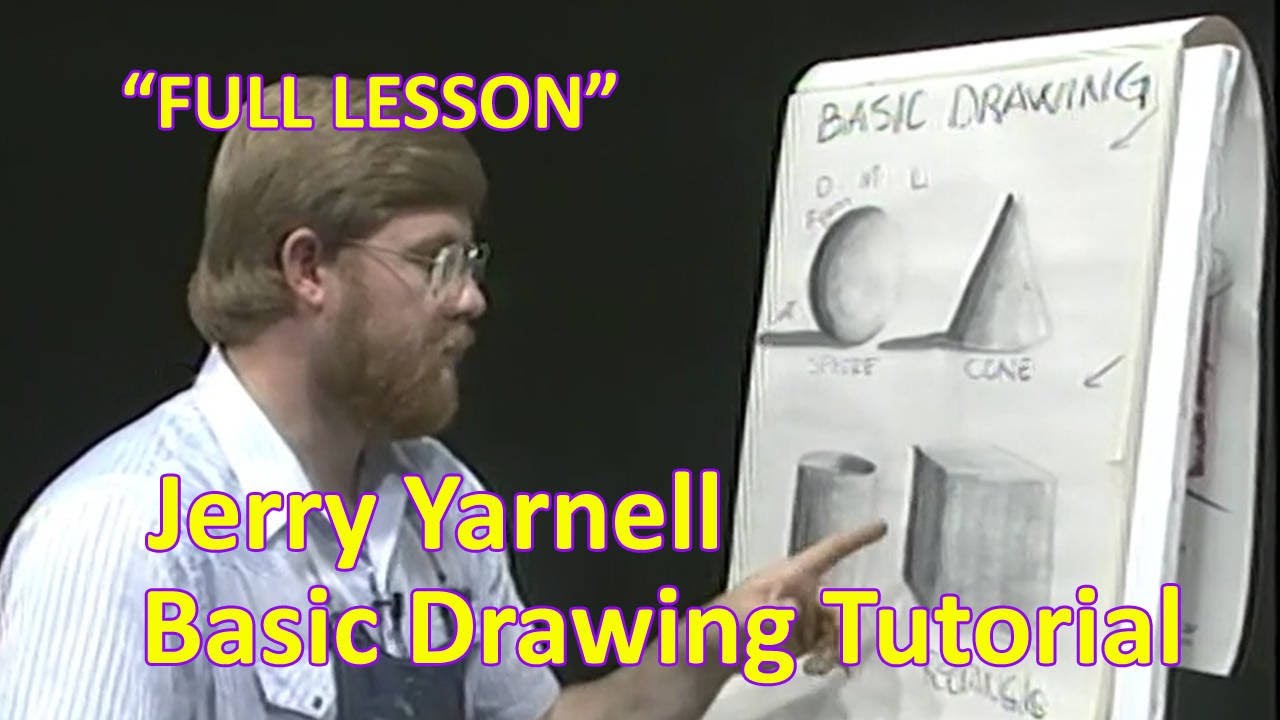
Jerry Yarnell picks up a piece of soft vine charcoal, rests three fingers on a newsprint pad, and draws a circle. Then he stops the class before it even begins. That shape has a name, he explains, and almost nobody uses it correctly, and that single distinction is where most painters quietly lose their way. For anyone who has ever finished a background they loved and then spent an entire afternoon repainting a bucket or a barrel because it refused to look right on canvas, what Yarnell teaches in this drawing primer lands with the particular relief of finally being told the obvious.
The four shapes everything in the world is made of
Yarnell opens with a brisk taxonomy that he says any serious fine art school would cover on day one. The first shape is not a circle. It is a sphere. The second is not a triangle. It is a cone. The third is a cylinder, not a tin can. The fourth is a rectangle, from which squares and cubes can be stretched or compressed at will. Yarnell pauses to let that settle, then sweeps his hand across his own drawing table: the cup of water, the roll of paper towels, the tube of paint. All four basic shapes, right there.
From shapes, he moves directly into shading, and here the lesson earns its weight. Every three-dimensional form carries exactly three values: a dark side, a middle value, and a light side. Yarnell demonstrates on the sphere first, pressing hard with the charcoal on the shadow edge, gradually releasing pressure as he crosses toward the light, then blending in a circular motion with his finger until the far outline of the ball can be erased entirely. The eye still reads it as round. That moment, the line disappearing and the form holding anyway, is the clearest illustration of what shading actually does.
He covers four shading techniques across the session. Block shading, which uses the side of the charcoal and a blending finger, is the foundation. Scumbling, a loose tangle of strokes applied with varying pressure, works well for fur, hair, and organic textures. Crosshatching builds value from overlapping straight lines, with the density of the gaps controlling the darkness, the same principle, Yarnell notes, that a printer uses when it renders dots on a page. Linear shading uses parallel curved lines without heavy overlap, and he points out a practical trick embedded in it: tucking the shadow slightly underneath an object makes the eye read it as rounder than the outline alone would suggest.
The barrel, the bucket, and why practice objects matter
The second session moves from exercises into application. Yarnell builds an old wooden barrel from scratch using nothing but a cylinder and the oval technique he drilled earlier. He sketches the top oval lightly, drops parallel vertical lines for the sides, mirrors the curve at the bottom, then carves out the barrel’s bulging silhouette by reading the negative space on each side. Once the outer form is established, he adds vertical wooden slats that curve more steeply as they approach the edges, then bands that follow the same arc as the top and bottom rims. Shading follows the same three-value rule, each slat getting progressively lighter as it crosses toward the light source from the right.
A tipped-over bucket comes next, this time with apples spilling out. The apples begin as spheres. The leaves beside them borrow from the cone. Yarnell places several spheres overlapping at different angles, then transforms each into an apple individually, adding a small reserved highlight, a shadow tucked beneath, and a cast shadow falling on whatever surface it rests on. As he put it plainly: ‘Most of you get the background painted and you feel good and you just paint this bucket over and over because you didn’t know how to draw in the first place.’
The tree that teaches everything at once
Yarnell’s most memorable exercise is a tree drawn in a single developing stroke. Starting at the bottom with heavy pressure on a roughly inch-long piece of charcoal held at a tipped angle, he moves upward with a jerky, irregular motion, letting the charcoal’s edge produce thick-to-thin variation naturally. Each branch junction is introduced as a small oval, and where a limb appears to emerge from the front of the trunk, a pair of short curved lines around it creates the illusion of depth. That technique, foreshortening, gets its own brief explanation: any object turned toward the viewer from its flat-facing position compresses into a new set of proportions, and the cylinder rule that governs the trunk governs every section of every limb above it.
The moment the newsprint fills up
By the end of the second session, Yarnell’s newsprint pad holds a sphere, a cone, a cylinder, a cube, a barrel with a cracked slat and a knot hole, a bucket with spilling apples at different angles, and a tree with foreshortened roots pressing into an implied ground. The charcoal dust from the blending has settled into the surface of each form.
Yarnell closes with the same instruction he opened with: pick up the charcoal, not the brush. Get the form right on paper first. Once that is done, transferring it to canvas with a charcoal sketch takes almost no time, and the painting technique can finally do what it was always meant to do.