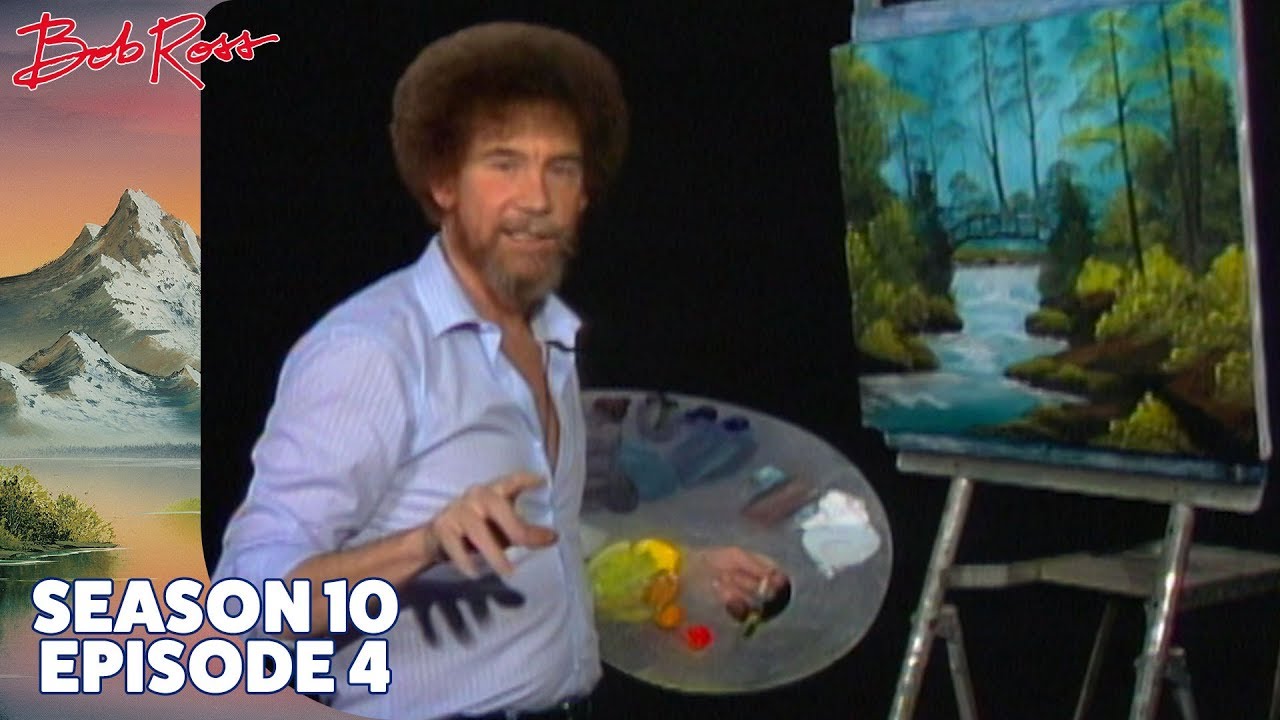
Bob Ross picks up a liner brush loaded with Van Dyke Brown thinned to the consistency of ink, tilts it to a sharp point, and pulls a bare tree trunk upward from a dark, misty background in one unhurried stroke. That small act is the heart of what he is teaching here: a forested stream scene with a hidden wooden bridge, built from almost nothing using pressure, patience, and a lot of paint. For anyone who has ever watched a canvas go from blank to finished in under thirty minutes and wondered exactly how that happens, this is the session to study.
The painting begins on an 18 by 24 inch canvas already coated in liquid white, wet and ready. Ross loads a brush with phthalo blue and sap green and dances the color across the upper canvas, alternating between hard pressure for the dark pockets and a feather-light touch where he wants the light to breathe through. ‘Don’t get it too even,’ he says. ‘We want it to be dark in areas and light in areas.’ A clean dry brush then pulls those strokes just far enough together to suggest trees at a distance without flattening them into a single tone.
How the water and the bridge find their places
With the background settled, Ross drops phthalo blue, sap green, and black into the lower canvas for a stream, starting at the darkest point at the bottom and letting the wet liquid white naturally lighten the color as the brush travels upward. The waterfall comes next, built with a fan brush loaded with liquid white and titanium white. ‘Just think how water would think,’ he tells anyone watching. ‘Pretend you’re water coming down here and having a good time.’ The fan brush drags across the canvas and the falls appear, with splash marks at the base and the suggestion of stones sitting just beneath the surface.
The bridge arrives almost as an afterthought, tucked behind a pair of dark bushes so that only the arc crossing the water is visible. Ross uses a palette knife to lay in Van Dyke Brown, then switches to a smaller knife to tap in the posts. A rail goes across the top because, as he puts it plainly, ‘we don’t want anybody to fall off this bridge and get wet.’ Tiny touches of brown and white catch the light on the posts, making the structure pop forward without overwhelming the shadowed scene around it.
Squirrels, raccoons, and the bird lady of Muncy
While the oval brush taps in leaf clusters and the fan brush adds mossy texture to stream-side stones, Ross mentions feeding squirrels at his home, which he calls ‘tree urchins’ because they live in the trees. He also talks about raccoons, possums, and bunny rabbits, and gives a quiet mention of a woman in Muncy who cares for injured animals and keeps him informed on how to look after the creatures he takes in. He calls her the bird lady and says he hopes to one day do a program showing what people like her do for animals across the country.
The liner brush, still loaded
The liner brush sits on the work surface with a point still sharp from the Van Dyke Brown, the long hairs holding a bead of paint thinned to the consistency of ink.
By the time the oval brush taps a last cluster of bright yellow-green leaves into the foreground tree and the clock on the wall signals the end of the session, the canvas holds a full world: misty distance, a churning stream, mossy rocks, dark bushes, and a small wooden bridge that most viewers will only spot once they know to look for it.