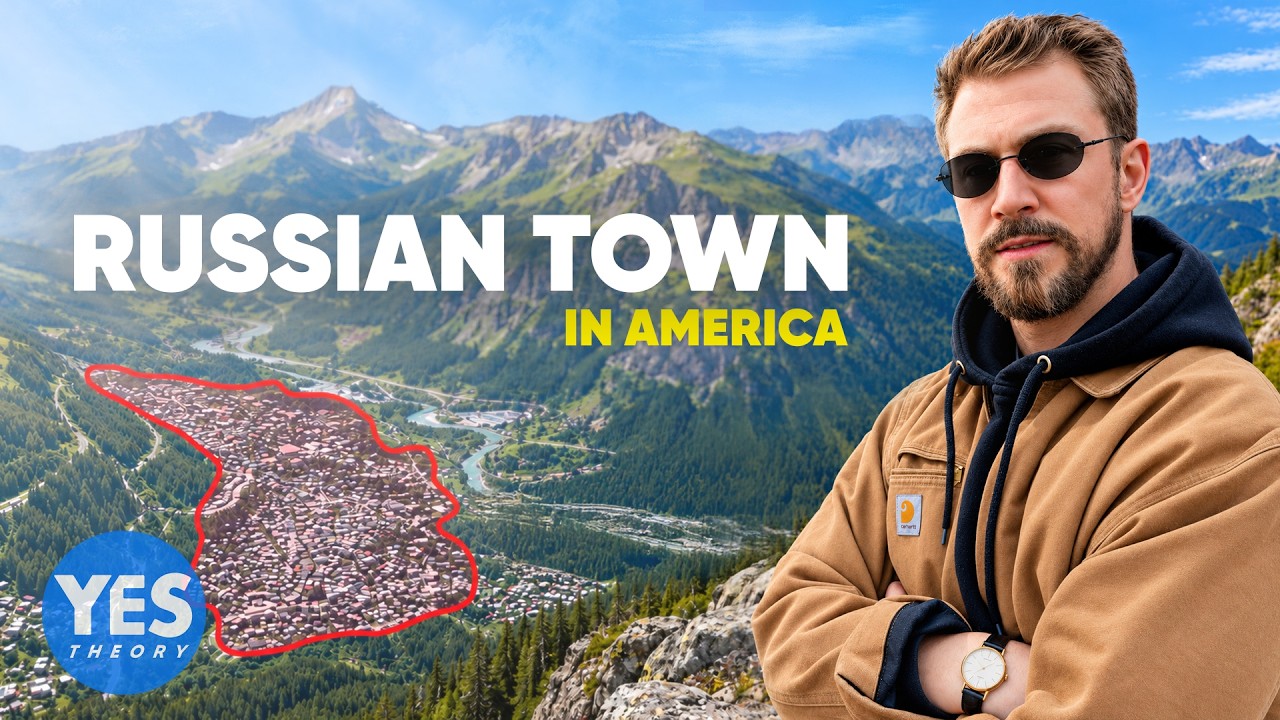
Kira had been working the same post office in Nikolaevsk, Alaska for over 30 years, sitting behind the counter doing jigsaw puzzles while the hours passed, and she had never once seen the glaciers that floated just across the bay. That detail matters because it captures everything strange and real about this place: a Russian-speaking village carved into the Kenai Peninsula wilderness where some families have lived for generations without ever needing to leave. Yes Theory arrived here following nothing more than a name scrawled on a cocktail napkin by a stranger in a bar in Paris, and what they found was not the guarded, hostile enclave they had braced for.
How a persecuted faith landed in the Alaskan wilderness
The Old Believers are a branch of Russian Orthodox Christianity that split from the established church more than 350 years ago when the head of the Russian Orthodox Church made sweeping changes to official customs, rituals, and texts to align Russian practice with the Greek Orthodox Church. To those who refused, those changes were false teachings. What followed was centuries of persecution: monasteries destroyed, religious leaders arrested, and believers sent to forced labor camps. After the Russian Revolution, the exodus accelerated. Many fled first into the most remote corners of Russia, then across the border into China. When communism took hold there too, they moved again, some settling in Brazil and Bolivia before traveling north to the United States. By the 1960s, several communities had gathered in Oregon, families reunited after taking wildly different paths across the globe.
But even Oregon felt too close to the modern world. Some worried that the longer they lived inside American society, the faster their language, faith, and traditions would disappear. So a small group looked further north, and in 1968, five families purchased a remote piece of land on the Kenai Peninsula, cleared the wilderness, and built a village from nothing. They named it Nikolaevsk.
A man working on his property near the edge of town had lived there since 1976 in a house his grandfather built by hand after escaping the revolution. He put it simply: ‘Freedom. That’s number one thing. Freedom number one.’
The post office, Nina’s cafe, and a day nobody planned
The center of daily life in Nikolaevsk turned out to be a post office where Kira, who arrived in 1969 at three months old, greeted strangers with the warmth of someone who has never lost the habit. She spoke Russian exclusively to her children when they were young, only for the school to push back. ‘They would tell us, don’t speak Russian in school because we don’t understand what you’re saying,’ she said. ‘But now my boys don’t speak Russian at all. That language is lost.’
From the post office, Kira led the group to meet her sister-in-law Nina, whose cafe operates by a logic entirely its own: the sign always reads open, Nina answers a call by texting back a menu, and she appears eventually with fireweed bread, borscht, rhubarb-and-raspberry dessert topped with whipped cream, and a full commercial she delivered directly to camera. ‘When I make anything, I pray and laugh,’ Nina said, already directing everyone at the table. Jeff, an American visitor who wandered in, was conscripted as waiter on the spot.
The next morning, the team organized a surprise for Kira: a bush plane tour over the glaciers she had spent four decades working a few miles from but never seen. She rated her fear a 10 out of 10 and said yes anyway. On the far shore of a glacial lake, surrounded by mountains and no one else, she led a prayer of thanks that landed harder than anyone had expected.
The 12-year-old with a Russian accent
Stefan, about 12 years old, met the group near the edge of town and guided them in by ATV. He spoke with a Russian accent, wore a traditional embroidered shirt he called by its Russian name, and had been born in the United States. His parents speak Russian at home. He had never heard of anyone quite like the people now standing in front of him, but took a copy of the Yes Theory book they offered, flipped to the Yakutsk feature, and recognized Siberia on the page immediately.
Kira was probably still in the same spot with her puzzle when the seaplane touched back down. She said so herself.
 Wake up to Only Happy News!