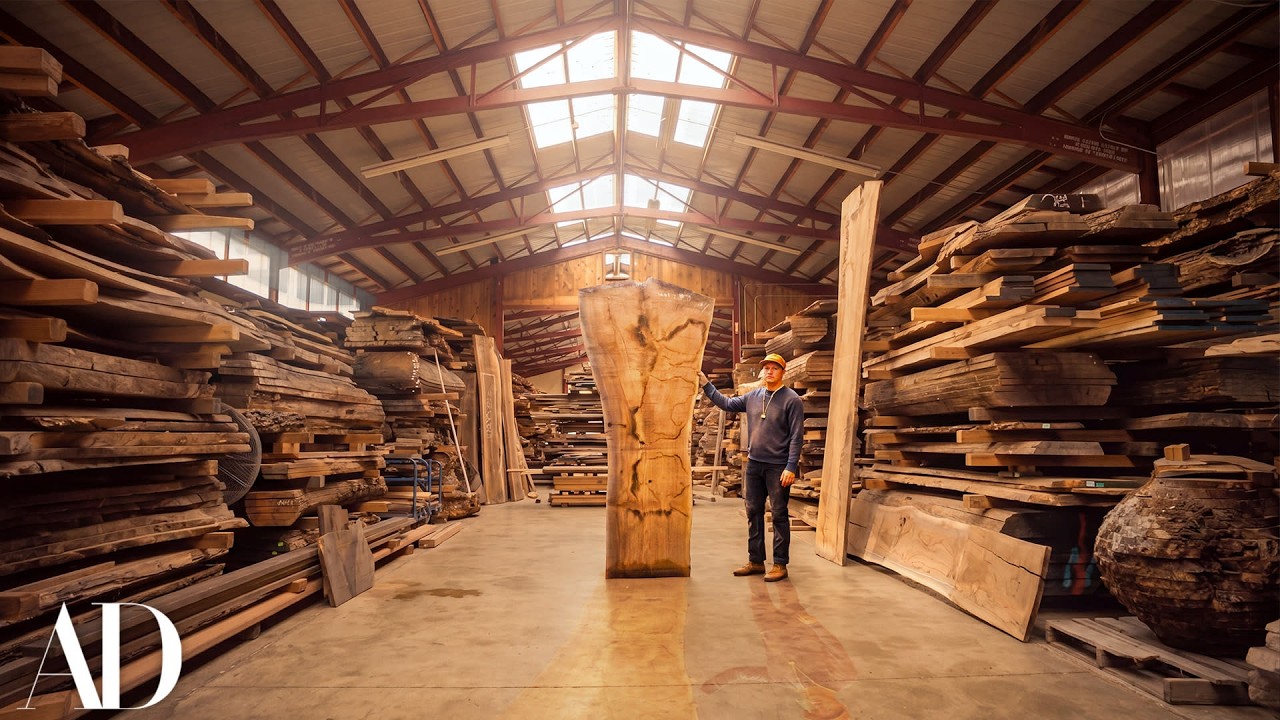
The pole barn at Nakashima Woodworkers is quiet enough that you can hear your own breathing. Michael, the craftsman who tends this space, is usually out here alone, moving slowly between slabs that weigh close to a thousand pounds and boards that have been resting on-site since before he joined the workshop. The collection he curates is not a lumber yard. It is a private archive of some of the rarest wood on earth, each piece carrying a provenance that cannot be replicated and, in several cases, cannot be legally sourced again.
When a Philadelphia architect changed his mind
The oldest wood in the building arrived in the 1960s. A Philadelphia architect imported a number of Persian walnut logs from Iran, and when they landed, he no longer wanted them. George Nakashima bought the entire lot. What remains of that acquisition sits in the barn today, dense and irreplaceable. East Indian rosewood occupies a small corner in rough chunks, used specifically for the bow-tie shaped butterflies that hold bookmatched slabs together and stop cracks from spreading. It cannot be legally imported anymore. When the current stock is used up, that is the end of it.
English oak burl, acquired by Mira Nakashima in the early 1990s, fills another corner. Some of those pieces run four inches thick and approach a thousand pounds each. A section of redwood root burl, pulled from below ground by a California sawyer George worked with decades ago, occupies its own section of the floor. The collection spans thirty to a hundred years of tree growth, and some of it has rested in this barn for most of that span.
The knots and bug holes that earn the highest prices
George Nakashima’s core insight, the one that Michael and the team still carry forward, was that the imperfections in a board are not defects to cut away. They are the story of the tree. A slab covered in dirt with knots, bug holes, and an uneven edge is not a lesser piece of wood. It is a more specific one. As Michael put it: ‘All of that is part of the story of that particular piece of wood and that particular tree.’
Price follows rarity, age, and width. Persian walnut sits at the top of that range. Walnut from Pennsylvania, New Jersey, and New York forms the backbone of the collection and of the workshop’s reputation. It is sustainably harvested from local properties, air-dried on site for at least two to three years depending on thickness, then kiln-dried before it reaches the craftsmen. From sourcing to finished furniture, the full process can take three or four years. A single dining table, depending on how many butterflies the wood requires, takes one to three weeks to build once the right slab has been chosen.
The slab nobody else picked
In one section of the pole barn, a rough-sawn board sits covered in bandsaw marks and surface dirt. The color of the grain and the depth of its figure are completely invisible at this stage. It will not reveal itself until it is planed down.
Some clients select their piece from photographs. Others walk through the barn and fall in love with a specific board on sight. For those clients, the board they choose becomes the entire project. Everything else follows from that one decision, in a building where most of the work, and most of the waiting, has already been done.
 Wake up to Only Happy News!