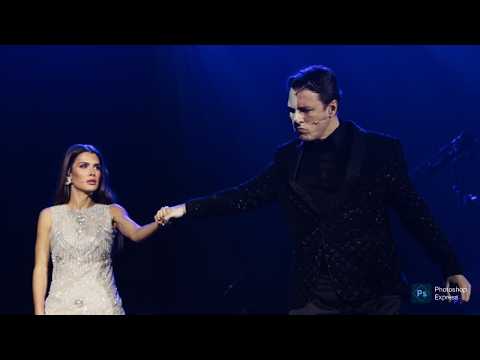
The first note Tamara Radjenovic releases hangs in the air like something borrowed from a dream sequence, and the room has not quite recovered by the time Vasa Stajkic answers her. That tension, the pull between a soaring soprano and a voice that commands rather than asks, is exactly what makes Andrew Lloyd Webber’s ‘Phantom of the Opera’ an enduring live performance piece. When two singers understand that the song is a confrontation, not a showcase, the audience feels it before they can name it.
When the room goes quiet before the applause
The performance opens with Radjenovic carrying the dreaming, drifting quality of Christine’s inner world, her phrasing shaped around lines that blur the boundary between sleep and waking. ‘In sleep he sent to me, in dreams he came,’ she delivers not as a declaration but as something remembered aloud, almost reluctantly. The vocal line floats, and Stajkic’s entrance cuts through it with an entirely different intention: persuasion shading into insistence. His Phantom does not accompany her so much as he encircles her.
What the two singers achieve together is a tonal argument. Radjenovic holds a brightness that keeps the character’s wonder intact even as the Phantom’s grip tightens in the lyric. Stajkic, for his part, leans into the role’s fundamental strangeness without tipping into pantomime. The line ‘my spirit and your voice in one’ lands with a physical weight that earns the sustained note that follows, and the audience responds to it with the particular silence that precedes a crowd deciding to erupt.
The moment the screaming becomes the instrument
The performance’s sharpest choice arrives in the final movement, when both voices abandon careful phrasing entirely. The raw, unguarded sound that Stajkic uses in the climactic cry is not a loss of control; it is a deliberate choice to let the character’s desperation be audible as texture rather than melody. Radjenovic matches it without mimicking it, lifting rather than leaning. The result is a duet that ends on something closer to confrontation than resolution, which is precisely where the material lives.
Radjenovic put the dynamic plainly in her aside before the final section: ‘Sing for me.’ Three words, stripped of ornament, delivered as if the Phantom is no longer asking.
A breath held between the final note and the first clap
The applause, when it comes, arrives in a wave rather than a burst, the particular shape of an audience that needed a half-second to agree with itself that what it heard was exceptional.
The stillness in that half-second before the room breaks open is where the performance actually lives, in the space between Stajkic’s last sustained note and the audience’s collective exhale, the same tension the song has been building toward from its very first measure.
 Wake up to Only Happy News!