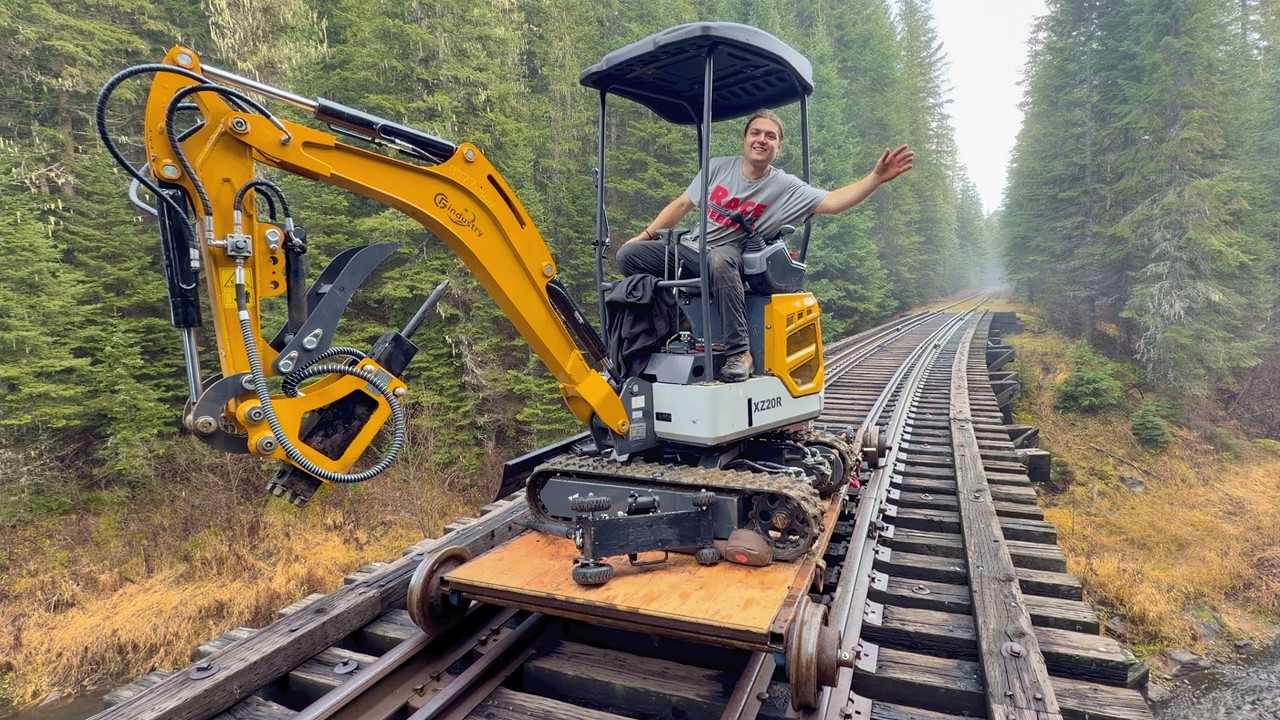
Deep in the mountains of Idaho, Matt Spears stood next to a Chinese mini excavator that had just sold at auction because nobody could get it running. The machine sat silent, smoke-free, and inert. What Spears saw was not a liability but a deal, specifically about half the cost of the same model available new online, if he could coax it back to life before the real work could even begin.
The stakes were real: an abandoned railroad stretched into the backcountry, its tracks warped and boulder-strewn after decades of neglect, and the only way to explore and clear it was to build a custom electric rail cart strong enough to carry a two-ton excavator. Nobody sells that kind of machine off a shelf.
A dead starter and a hammer fix that probably should not have worked
Spears traced the excavator’s silence to a seized starter motor. After pulling it free, he tried something he had read about online: hitting the starter with a hammer. The starter began spinning. He reinstalled it, turned the key, and the engine fired immediately with a cloud of smoke that made him laugh out loud. All the hydraulic controls worked. The machine was perfect.
With the excavator running, he moved to his workshop and began fabricating a rail cart from scratch on a 4-foot by 10-foot welded steel frame. The electric motor he mounted to it puts out 35,000 watts. The wheels he sourced are 107-year-old original gold mine cart wheels, each weighing over 50 pounds, acquired years earlier but never usable because of their sheer mass. Welding them presented the hardest technical challenge of the build: cast iron behaves more like glass than steel, so Spears preheated each wheel to around 500 degrees Fahrenheit, TIG welded in short sections, peened each pass with a pointed hammer to relieve stress, used a high-nickel welding rod for flexibility, and buried each finished wheel in a bucket of sand to slow the cooling. He had never welded cast iron before.
Ryer and the simulators at the University of Idaho
On the way to the test site, Spears stopped at the University of Idaho to meet Ryer, a professor of forest operations, who showed him full-cab logging simulators and explained how hydraulics transformed an entire industry. Ryer described a logger in his seventies who still remembered the first cable-driven log loader he ever ran, and how everything changed when he moved to hydraulic equipment. He also mentioned that the University of Idaho grows roughly half a million trees a year, harvests them with students, and sells the timber to fund the college. ‘We grow the trees, we manage them as students do, we harvest them with the students, and then we sell them to products manufacturers,’ Ryer explained. As far as he knew, no other university in the country runs that complete a cycle.
As Spears put it plainly after climbing down from the simulator: ‘That’s the power of hydraulics.’
The cracked wheel nobody saw coming
Out on the abandoned line, things went sideways fast. The hydraulics cut out completely on the steep grade, then inexplicably fixed themselves. The cart derailed on a section of track worn concave by 80 years of train traffic. And when Spears checked his wheels after the derailment, one of the cast iron wheels had cracked on both sides. He owned the mistake immediately: the weld had failed, not the crash. He had done the research, tried to do it right, and still got it wrong.
He got the cart back on the rails anyway, tested the hydraulic rock hammer (it worked better than expected), nursed the damaged wheel across two trestles through thickening fog, and made it back to the truck before dark.
The trestle he almost talked himself out of crossing
The first trestle stopped him cold. He climbed down and walked the structure from underneath before committing a 3,000-pound machine to it. The wood was intact, nothing missing, no holes. He called it brand new compared to others he had crossed.
The cracked gold mine cart wheel sat on the rail cart at the trailhead, still holding the machine’s weight, still turning.
Spears had planned the whole trip around testing the rock hammer. After everything that broke and fixed itself and broke again, the hammer worked perfectly on the first try.
 Wake up to Only Happy News!