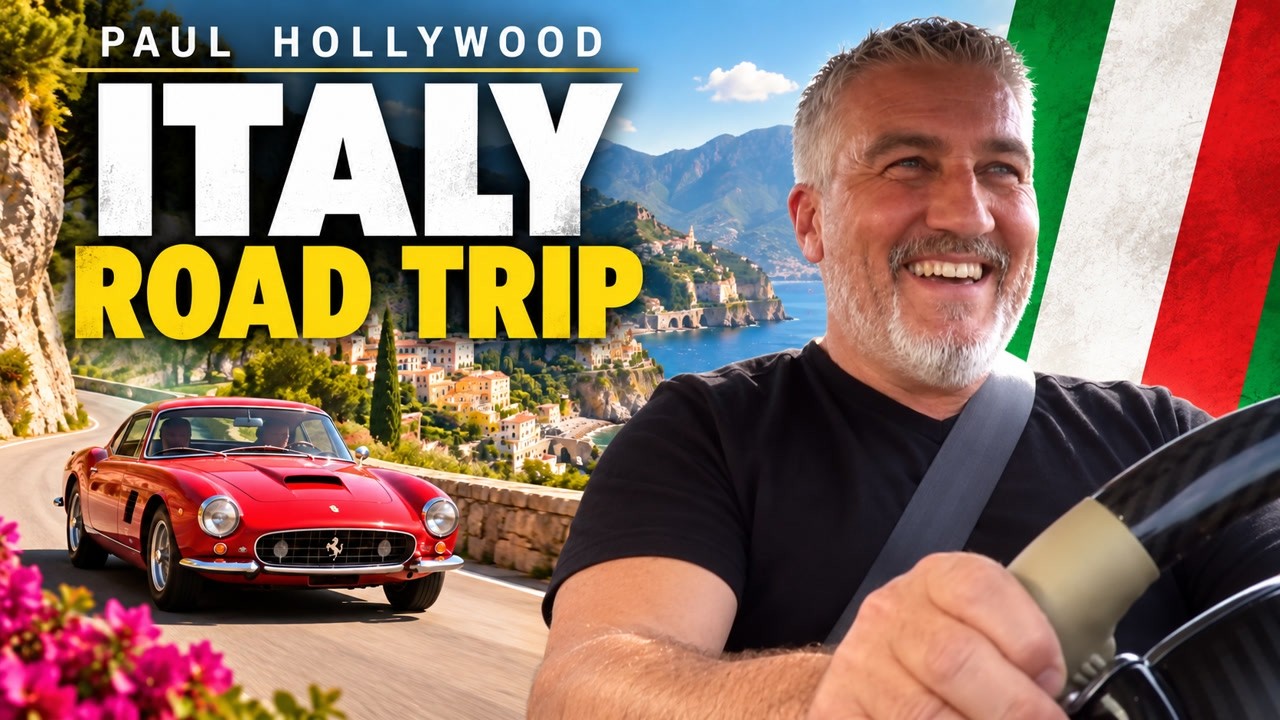
In a narrow Roman piazza, a Lamborghini Huracan Spider in orange sits idling at a zebra crossing while pedestrians stare, phones already raised, as the driver behind the wheel decides the light situation is someone else’s problem. That driver is Paul Hollywood, bread baker, part-time racing driver, and a man who had a poster of a Lamborghini Countach on his wall as a boy. The question he brings to Italy is not just about the cars. It is about why a country that voted itself the worst drivers in Europe also builds the most emotionally electric machines on earth. Six days. One thousand miles. And a lineup of vehicles ranging from a quarter-million-pound supercar to a three-wheeled laundry van with doors that will not stay shut.
Rome on its own terms
Hollywood’s guide through Rome is choreographer and Strictly judge Bruno Tonioli, a man who believes mirrors exist exclusively for checking your eyes and that the lines painted on Roman roads are, at best, a suggestion. The pair cut through Piazza Venezia in the Huracan, 600-plus brake horsepower and a price tag of just under £200,000, which works out to roughly ten years of take-home pay for the average Italian. Strangers stopped mid-stride to photograph it. Bruno’s read on this was simple: ‘There is no envy. He is celebrating.’ The chaos of Roman traffic, which sees almost 90 percent of accidents caused by drivers ignoring the rules, turns out to function as a kind of collective improvisation. At Piazza Venezia, Hollywood met Fabio Gilo, a municipal police officer who has directed traffic there for ten years, selected from more than 2,000 applicants and trained for three months before he was allowed onto the piazza. The automatic platform he stands on broke a year before Hollywood arrived and had not yet been fixed.
From Rome the journey swings north in an Alfa Sud, a car whose story reads as classically Italian: brilliant engineering sabotaged by cheap Russian steel and a workforce of hastily recruited farmhands, door handles that fell off, windscreens that dropped out. The one Hollywood drove held together long enough to reach Maranello, where for seven euros anyone can rent a red Ferrari and drive it around the birthplace of the brand. Twenty euros gets you the footage. Of the roughly 7,000 Ferraris built each year, only three percent are sold in Italy, yet Italians spent around £125 million on Ferrari merchandise last year. The mayor of Maranello put the attachment plainly: Ferrari cars, he said, are made of ‘the brain and the blood and the earth of the people who built them.’
From three wheels to titanium bolts
Just down the road, at the Pagani factory, 45 cars are hand-built each year, each taking four months to finish. The cheapest starts at two million euros. Every one of the 4,000 bolts in a single car is grade-seven titanium, handcrafted, and carries the Pagani logo etched into it. The dashboard instruments are made by an Italian watchmaker; the numerals are cut from the metal face itself and cost around five thousand euros per set. Hollywood got behind the wheel of a secret prototype Roadster, the only non-Pagani test driver ever to do so, while the company’s test driver Andrea Palmer sat beside him growing visibly tense before eventually relaxing into the speed.
In Verona the register drops completely. Hollywood spent a morning delivering shirts in a Piaggio Ape, a three-wheeled van still in production after two million units sold, with a throttle, a brake, and doors that opened and closed according to their own schedule. Marco Zambaldo, president of the Verona Ape Owners Club, explained that after the Second World War, with the Italian economy on its knees, the Ape gave ordinary people a cheap way to start and run businesses. It has never really left.
The Fiat 500 in Turin, the Panda 4×4 in the Alpine town of Champoluc, the 1938 Alfa Romeo 6C valued at around £3 million whose owner trailed nervously behind in a modern Alfa to make sure the gears survived: each car opened a different layer of the country. Style guru Elanora Galasso, riding through Turin in a vintage Cinquecento, summed up the Italian relationship with design by pointing at the car’s folding roof. The roof was not an aesthetic statement. It was a cost-saving measure on metal. ‘Style has nothing to do with money,’ she said, ‘but you have to have all the details right.’
Oranges, horses, and a Lamborghini Miura
The final day brought the Lamborghini Miura, the first true supercar, launched in 1966, mid-engined, rear-wheel drive, and so low to the ground that walking pedestrians presented an unavoidably intimate view at eye level. Comedian Francesco Dario rode along and explained the Italian driver’s hand position: not ten-to-two but straight midday, one hand on the wheel, to show, as he put it, that you are a cool guy making la bella figura. The gesture for insulting a fellow driver, still widely used, is an ancient sign meaning your wife is cheating on you.
The trip ended in the town of Ivrea at the Battle of the Oranges, a festival dating to 1808 in which the town’s residents re-enact a revolt against their landlords by pelting each other with citrus fruit from horse-drawn carts. Hollywood watched from behind netting, then walked in anyway and took several oranges to the face.
A floor covered in oranges, horses, and something else
At the end of it, standing on the festival ground, Hollywood looked down at what had accumulated underfoot: oranges, horse, and blood.
Francesco Dario had said it somewhere between gesturing out the window of a 1966 Miura and describing Italian drivers as brave and cowards simultaneously, noisy and passionate, all extremes compressed into the same vehicle: ‘You can be hurt. You can be killed. But you will never get bored in this country. Never.’ A thousand miles of evidence suggested he was right.
 Wake up to Only Happy News!