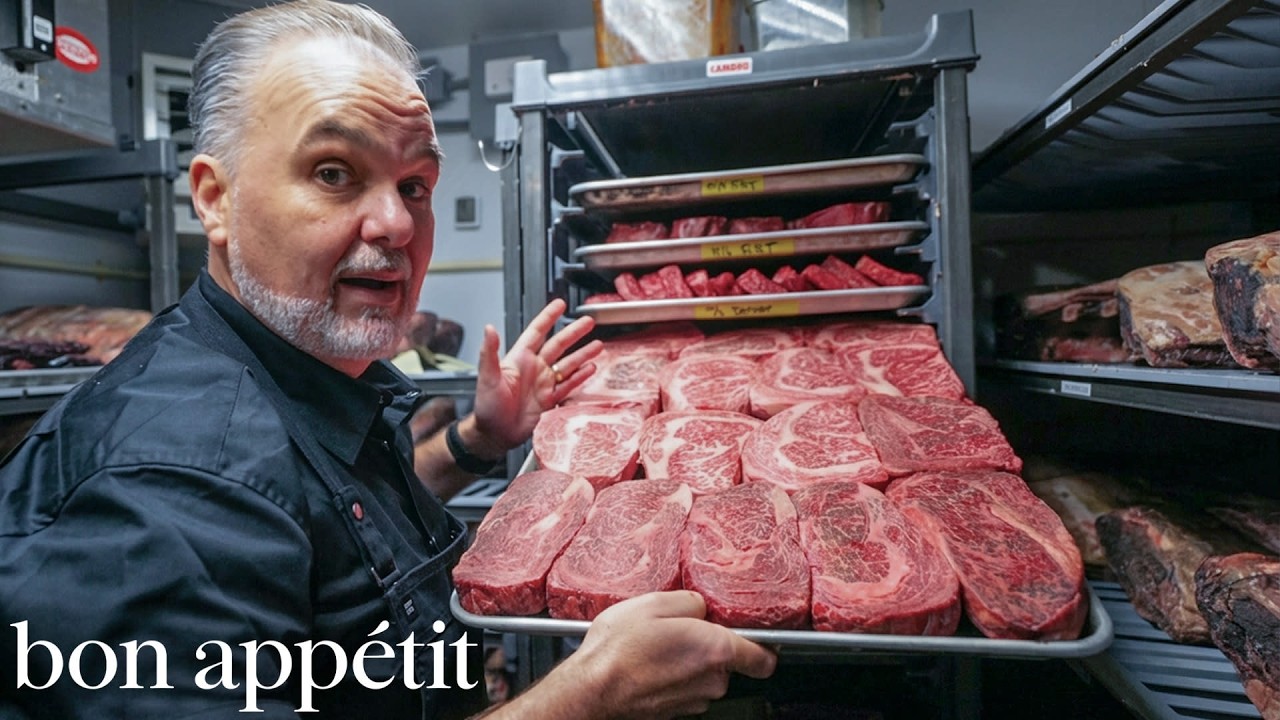
At 5:00 AM, the prep team at Sunny’s Steakhouse in Miami is already inside the butcher chamber, breaking down bone-in ribeyes that have been dry aging in-house for 35 to 45 days. By the time executive chef Aaron Brooks walks through the door at 8:00 AM, two full-time butchers have already been at work for hours, and the day has barely started. For a restaurant doing 500 to 600 covers every single night, from 5:30 until midnight, there is no other way.
The dry age room is where it starts
Brooks calls the butcher chamber his happiest place in the restaurant, possibly edged out only by the dry age cooler right behind it. The beef coming off those shelves is USDA Prime Black Angus from the Midwest, cut at around 30 ounces and trimmed to a 26-ounce serving portion after the bark and mold are cleared with a bone scraper and a band saw. That mold is not a problem. It is the point. After 40 days on the shelf, it gives the meat what Brooks describes as a beautiful, nutty flavor. Aussie lamb racks, American wagyu with fine-grain marbling from purebred animals, and Hudson Valley duck breasts dry aged for 10 days on a cage all share that same cooler, all staged and portioned well before service.
The in-house butchery extends into charcuterie. Berkshire pork ground with dry aged fat from the prime exports, seasoned with chili, pequillo pepper, and a touch of white wine, gets stuffed into pork casing, pricked for air pockets, twisted into four-inch links, and left to dry before hitting the charcoal grill. Every sausage on the menu was always going to be made exactly that way. ‘Whatever we put on the plate in that dish, it’s going to be made here,’ Brooks said.
Seven hundred rolls and a hundred orders of pasta before dinner
Parker House rolls are one of Sunny’s signatures, and the numbers are unambiguous about why. The team makes 700 to 750 of them each day and nearly sells out every night, sending 350 orders of two across the pass. The dough is enriched with eggs and a significant amount of butter, baked at 375 degrees with a scoop of ice added to the oven to raise humidity, finished with Maldon salt and poppy seeds, and served warm alongside Vermont butter doused in honey.
The pasta operation runs in parallel. Five shapes on the menu. Three to four hours of daily prep. The sweet corn agnolotti alone accounts for 1,200 to 1,800 individual pieces on a given night, 15 pieces per order, roughly 100 orders a day. The filling is sweet corn slow-cooked with shallots, white wine, and butter, then pushed through a fine chinois until the texture is completely smooth. The finished dish is tossed in a brown butter sauce with pepper oil, blue crab, a squeeze of lime, and chives.
The Kouign-Amann ice cream sandwich is the dessert that arrives on an octopus vessel. A laminated Danish dough, layered with premium butter, cut into two-inch squares, folded into tulip shapes, baked hard and fast until the sugar caramelizes into a glassy shell. Around 200 are made each day. A pastry cook named Kouignie handles both the pastry and the churned vanilla bean ice cream that goes inside. ‘If your butter gets too warm, it’s going to split inside the layers,’ Brooks said. ‘You really have to know what you’re doing.’
The bluefin that arrived whole from Mexico
At 2:00 PM, the seafood delivery came in. A whole bluefin tuna from Mexico and a whole hiramasa from New Zealand. A cook named Ian worked the hiramasa with a sukibiki technique, using a knife at a precise angle to lift scales without breaching the flesh, then hung it in the dry ager on a hook. The tuna was broken into separate cuts by fat content: otoro from the belly, chutoro from the mid-section, and lean akimi near the bloodline, all destined for a Sicilian sashimi at $24 per order. ‘Some people might look at it as just a few slices of fish with some salsa on top,’ Brooks said. ‘But the care and love that has gone into it, not only through sourcing but also processing, is pretty impressive from start to finish.’
At 3:00 PM, the team sat down for family meal. At 5:00 PM, Brooks ran the pre-shift briefing. Six wagyu bone-in KC strips at $160 each. The bluefin tuna sashimi back on the menu. 500 covers on the books.
A pelican that holds the french fries
Amid all of it, one specific object in the dining room gets called out by name during service. A pelican-shaped vessel, used to serve french fries out of its mouth. ‘Who doesn’t want a pelican with french fries coming out of the mouth of it?’ Brooks said. It is one of several antique and one-off pieces the team calls ‘treasures,’ each chosen because no two are alike, and because a guest who gets the pelican gets something nobody else in the room has that night.
By 5:30 PM, the doors are open, the kitchen is firing, and the pelican is somewhere in the room, waiting to be called for.
 Wake up to Only Happy News!