Destin Sandlin grew up in North Alabama smelling cutting fluid on his parents’ clothes when they came home from the plant. Both of them were United Auto Workers members who made steering components for vehicles, and that smell meant something to him: people were building things, and the town was alive because of it. For anyone who has watched that kind of industrial ecosystem quietly disappear, the question Sandlin decided to answer matters far beyond a single household product. What actually happens when you ignore every market force pushing you overseas and try to manufacture something at home?
The chain mail, the bolts, and the supply chain that kept fighting back
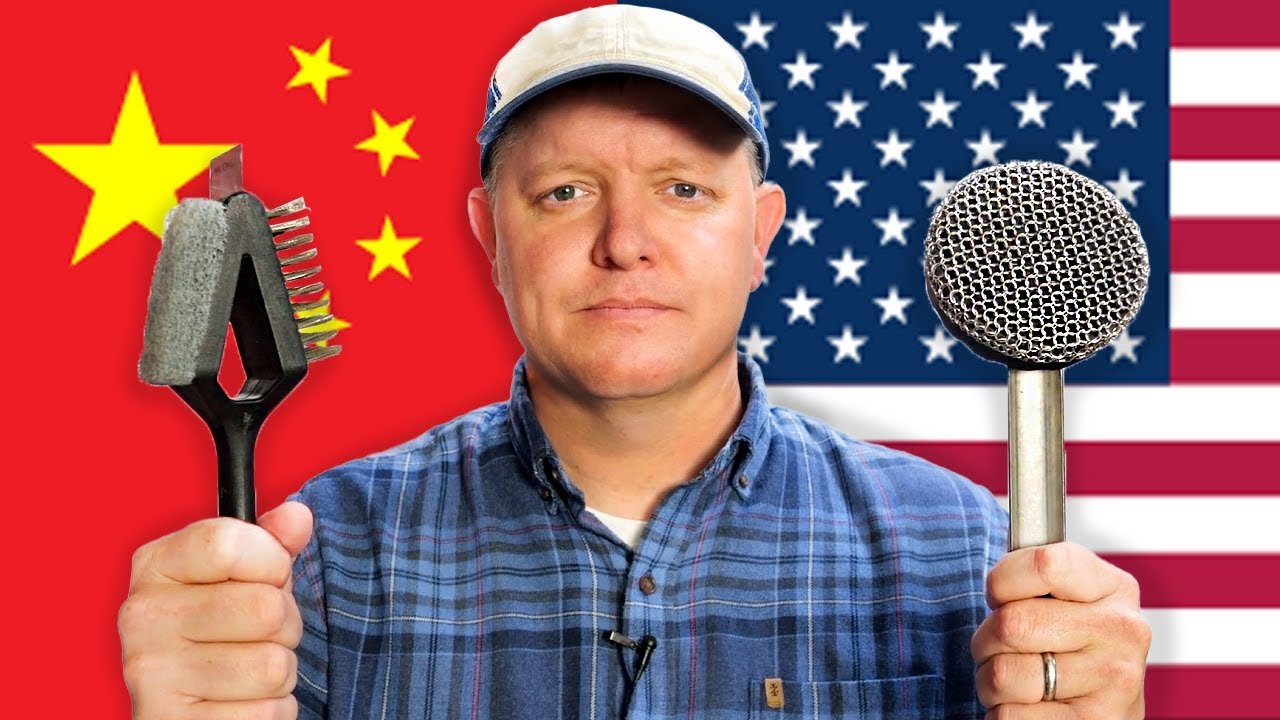
The Smarter Scrubber is a grill-cleaning tool built around a pad of chain mail that wraps compliantly around grill grates, backed by a food-grade silicone cushion and driven by a stamped-steel handle. The concept came from John Youngblood, who owns a small grill-products business called JJ George and had already experienced the particular pain of watching overseas manufacturers clone his patented products and undercut him on Amazon. The two decided to work together, with Sandlin handling engineering and fabrication and Youngblood handling the business side, and they set a single rule: make everything in America.
Nearly every component pushed back. A standard one-inch stainless steel quarter-20 bolt costs roughly nine cents from a foreign supplier. Sourcing the same bolt made in the United States took months of emails and cold outreach, eventually landing at around a quarter per bolt out of Massachusetts, with a later find at 19.56 cents each. The chain mail required an octagonal rectangular grid pattern that the most common radial designs on the market could not replicate. Sandlin found a domestic supplier, but their production capacity topped out at roughly 2,000 units a month, which was not enough to cover a potential surge in orders. An Indian supplier was brought in to cover the gap. Then, while filming the story itself, Sandlin and a colleague examined a pallet of that Indian chain mail and found Chinese characters printed on the packaging. A quick translation confirmed the text referenced Shanghai culture. As Sandlin put it on the spot: ‘It always goes back to China.’
The injection molds told a different story, and a harder one. When Sandlin first approached a molding facility and asked to have the molds made domestically rather than in China, the response was blunt: ‘Good luck.’ That moment, he said, brought the entire experiment into focus. The smart work, the tool and die knowledge that once defined American industrial capacity, had been quietly hollowing out for decades. He ended up working with Chris Robeson, the same Alabama mold maker who had helped his community produce face shields during the pandemic, using 3D-printed Formlabs Rigid 10K inserts to verify geometry before cutting production molds in metal. The silicone pad required a separate nine-cavity mold made by a Virginia company called Commonwealth Manufacturing because the original thermoplastic material melted during grill tests.
The apprentice, the engineer who passed away, and a new kind of worker
The stamped-steel handle took Sandlin to TNC Stamping, where he met a tool and die expert named Roger who, in Sandlin’s words, had forgotten more about the trade than most people know. Roger passed away between the time Sandlin filmed the stamping process and the time this story was completed. But something else happened at TNC that Sandlin keeps returning to. A young man named Logan, who had been working as a press operator, entered the company’s apprenticeship program and spent six weeks building the station tooling that forms the Smarter Scrubber handle. It was the first tool Logan had ever made. Asked whether he had imagined having this skill, Logan said simply: ‘I never knew anything like this really existed.’
Ted, the CEO of a metal 3D-printing company called Mantle, joined the project to solve the final remaining non-American component, a small knob that arrived from the supplier labeled made in Costa Rica rather than the United States as promised. Ted also had personal skin in the game. He had once eaten salmon at a backyard barbecue and impaled the back of his throat with a steel wire bristle from a conventional grill brush, removing it at home with a pair of forceps. He noted that his brother, an ear, nose, and throat physician, sees patients with the same injury every single summer.
The young man named Logan and his first tool
The station tooling Logan built sits inside a press at TNC Stamping. Flat laser-cut blanks feed in at one end, and the press moves each one through a sequence of bending stations, the final one curling the handle into a tube around a side action, until a finished steel scrubber handle drops out the other end.
The four-year experiment produced a working product, a domestic supply chain that is still being completed, and a very specific number that stayed with Sandlin: in the 1980s and 1990s, tool and die workers earned roughly 20 percent above the average American income. Today that figure sits approximately 15 percent below it. The knowledge is still there, just waiting for someone to decide it is worth paying for again.