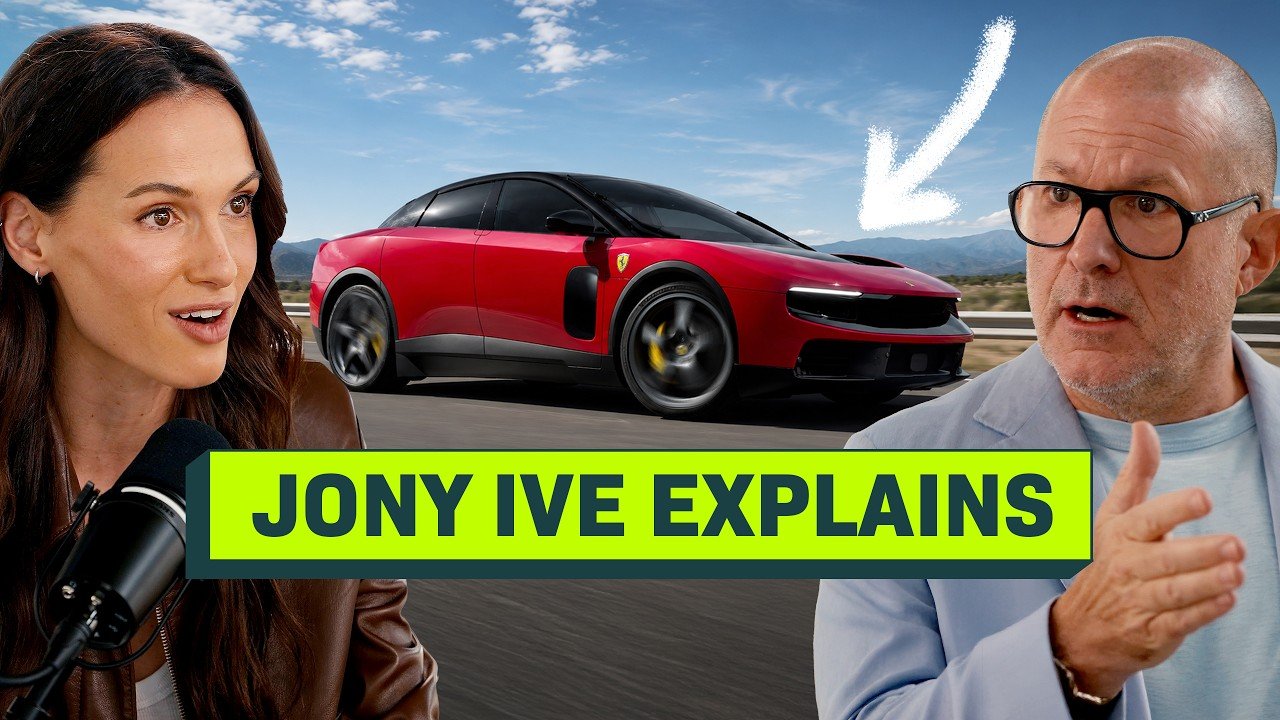
A leather-backed, stainless steel-sided key with a glass front goes into the ignition of the Ferrari Luce and the yellow indicator light slowly migrates across to the drive selector. No roar. No vibration. Just a deliberate, physical signal that something new has started. That moment, described in detail by Jony Ive while sitting inside the car at a secret track in Italy, captures the central argument of the first ever all-electric Ferrari: authenticity over imitation.
The Ferrari Luce is not simply a new powertrain inside a familiar body. It is the first five-seat Ferrari ever built, a car the company once said it would never make, developed through an unlikely collaboration between Ferrari’s in-house design culture and Ive’s San Francisco-based team, which worked independently for around eight months before presenting its initial concept. Ferrari chairman John Elkann drove the decision to bring in an outside perspective, according to Ferrari chief designer Flavio Manzoni, who described the initial reaction as ‘a little bit shocking.’
Why the car ended up with five seats instead of two
The answer sits beneath the floor. An electric platform places the battery pack under the cabin, eliminating the central tunnel that a combustion engine and drivetrain demand. Manzoni described it plainly: ‘It’s like tabula rasa, you can do whatever you want.’ That freed interior volume made a five-seat layout physically possible for the first time in Ferrari’s history, and the engineering team chose to use it rather than simply redistribute the space.
The same platform logic shaped the exterior aerodynamics. With no engine in the front, engineers could lower the nose significantly. The body is organized around two primary volumes: a wedge-shaped glass house on top and what Manzoni calls an exoskeleton below it, which generates two wings, one at the front and one at the rear, channeling air to reduce drag. Where a combustion Ferrari like the F80 is engineered to generate downforce, with the F80 producing 1,500 kg of it at 250 km/h according to Manzoni, the Luce prioritizes drag coefficient because battery efficiency depends on it. The wheels are flat. The body sides are nearly continuous. The design language is built around what Ive’s team calls a ‘squircle’, a rounded square form that appears across both the interior and exterior, including the front and rear ends.
On paper, the performance figures are substantial. Four electric motors, one per wheel, produce 1,035 horsepower. The car reaches 100 km/h in 2.5 seconds, carries a top speed of around 310 km/h, and offers an estimated maximum range of around 530 km. Ferrari has not confirmed pricing, though the car sits at the high end of its range. An independent estimate from the interviewer puts the figure at around $650,000.
What Jony Ive refused to do with the interior
When Ive walked through the cabin at the secret Italian track, the absence of fake engine sound was the first thing he addressed. Other electric cars add synthesized audio to simulate combustion. Ive declined that approach entirely. ‘The obvious thing, or certainly the easy lazy thing to do, would be to mimic what people are familiar with,’ he said. ‘I think consumers and users are really smart. I think they’re really discerning and I think that they value authenticity. They know when it’s fake.’
The interior reflects the same philosophy. Physical toggle switches, rotary dials, palm rests, and a tactile steering wheel with what Ferrari calls a ‘manettino’ dial replace the touchscreen-dominant surfaces found in many competitors. The manettino cycles through driving modes and displays color-coded feedback: orange for sport, fading back toward white once registered, to maximize contrast for function. Ive noted that multi-touch screens require the driver to look away from the road for basic operations, a design failure he described in blunt terms: ‘People are dying because of dumb design.’ The Luce does include a screen, but it is treated as one element within a physical environment rather than the primary interface. The co-pilot panel adjusts its position and has a handle that, as Ive demonstrated, users reach for and grip naturally without instructions.
To document the design thinking before build began, Ive’s team produced four books. Those books have not been publicly released. One was brought to the interview, and a passage from it was read aloud: ‘We often think of the Swiss watch industry during the electric quartz revolution. It’s hard not to see parallels between valuable historic brands like Patek Philippe who survived and grew into the transition primarily because it retained its traditional mechanical movements. If it had been legislated that Patek Philippe had to transition its entire product line to quartz, the resulting challenge would appear similar to the transition Ferrari is facing.’ Ive acknowledged the parallel directly, describing the comparison as an ‘acknowledgement of the massive change that the world is going through in electric cars.’
Manzoni grounded the decision in global market context. In 2011, the then-CEO of Ferrari said Ferrari would never make an electric car. At that time, the most popular electric vehicle in the world was the Nissan Leaf and Tesla had not yet launched the Model S. Today, according to figures cited during the conversation, 25% of new vehicles sold globally are electric, with the figure exceeding 50% of new car sales in China and sitting around 25% in Europe. In the US, the share is around 10% and has been flat since 2023. Ferrari delivered 13,640 cars in 2025, according to figures raised during the conversation, with 81% going to existing Ferrari owners and 48% to people who own more than one.
Flavio Manzoni and the sentence he keeps returning to
Manzoni quoted the philosopher Erich Fromm during the conversation at the track: ‘Creativity requires the courage to let go of certainties.’ He said it was the most precise description of the Luce project he could find. He also quoted composer Gustav Mahler on tradition: ‘Tradition is not the worship of ashes. Tradition is the preservation of fire.’ And he cited architect Adolf Loos on continuity: ‘Tradition is the uninterrupted chain of all the innovations.’ These were not rhetorical decorations. Manzoni used them to explain why Ferrari did not simply make a two-seat red electric car that looked like what people already picture when they think of the brand. ‘We never use design features of a car for another car,’ he said. ‘This is not our approach.’
He pointed to the Ferrari F40 as a historical anchor. The F40 was among the last cars produced while Enzo Ferrari was alive and its sharp, angular, technical shape was a radical departure from the curved, romantic forms that preceded it. Manzoni’s reading of Enzo’s legacy is one of continuous forward pressure. ‘The approach of Enzo was always about vision and about progress,’ he said.
Ive, for his part, connected the project to a longer view of what design is for. ‘In many ways, I think I’ve always seen myself as a tool maker,’ he said. ‘What makes me the most happy is to be elevating humanity, trying to make a contribution, trying to provide tools that move the species on.’ He acknowledged unpredicted consequences from past work, including work on multi-touch technology, without deflecting responsibility for them. ‘I do feel that responsibility and that drives the decisions that I have made and I’m making for how I can try and contribute in the future,’ he said.
When asked what Steve Jobs would have said about the Luce, Ive declined to speculate. ‘I wouldn’t presume to say how he would respond,’ he said. ‘But I owe so much of what I’ve learned to him and I know I wouldn’t be sat here if it wasn’t for him.’
The key with a glass front
Sitting inside the Luce at the secret track, Ive held the key and described it again: leather on the back, stainless steel on the sides, glass on the front. When it is inserted, the yellow light moves and settles on the drive selector. It is a small object doing a specific and deliberate job, carrying no imitation of anything that came before it.
Back outside the car, on a private circuit somewhere in Italy, the Luce sits as a five-seat, 1,035-horsepower bet that a company famous for two-seat combustion machines made without any sense of obligation, according to Ive, and with the same key going into a slot that starts everything quietly and from scratch.
Source: Watch original
This article was reported in June 2026.
OHN Editorial Note: This article is based on publicly available sources. If you spot an error or have updated information, contact us at editorial@onlyhappynews.com. We correct mistakes promptly.