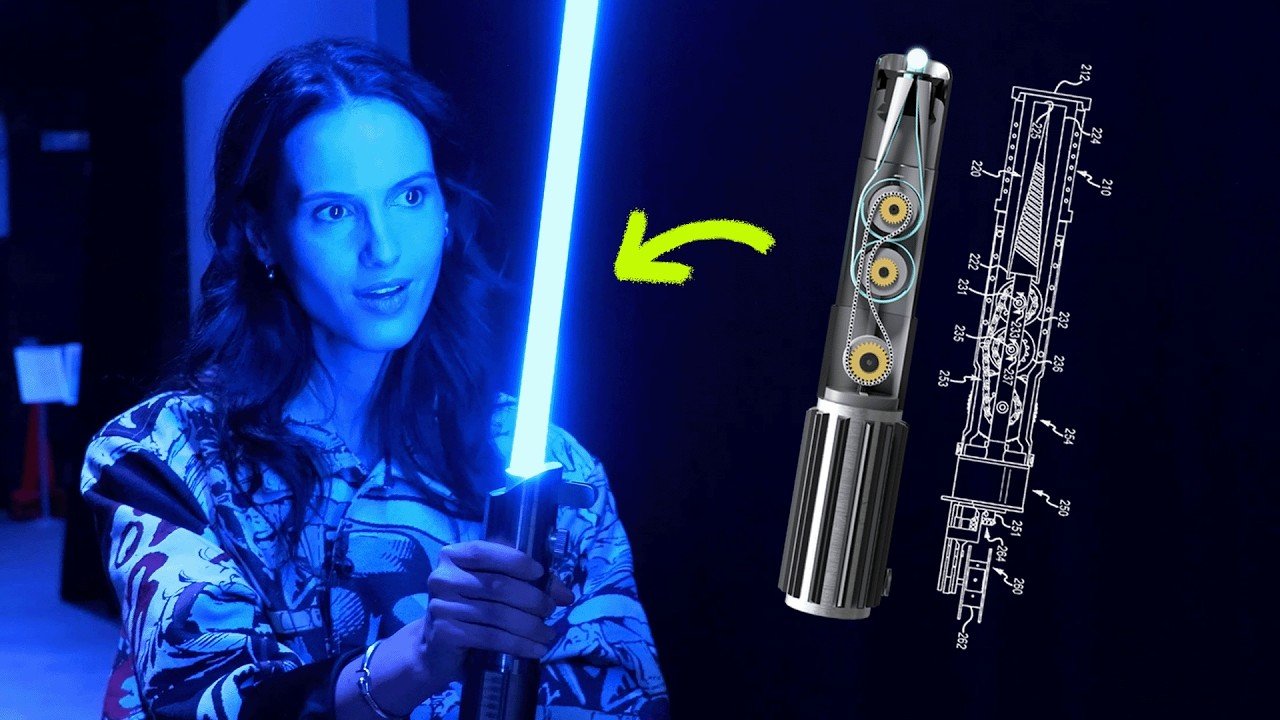
Lanny Smoot held out a prop, stepped back a half-pace, and told journalist Cleo Abram to press the button. She did. The blade extended smoothly upward, glowing and flickering as though it had always existed, and for a moment the Walt Disney Imagineering research lab went very quiet. That single button press is the result of more than 100 patents, decades of engineering, and one very specific creative problem: how do you make a lightsaber feel real for a live performer standing in front of a crowd? The answer turned out to reshape what people believe is physically possible, and it is only one of several inventions Smoot and his fellow Imagineers have quietly built inside their R&D facility.
How the lightsaber blade actually works
Every toy lightsaber that came before this one fails the same way: the blade either snaps out rigidly in sections or collapses like a foam pool noodle. Neither reads as real from ten feet away, let alone up close. Smoot’s version solves the problem mechanically. Inside the hilt, two long translucent tapes sit coiled around internal motors. When the button is pressed, those motors push the tapes upward and out of the hilt. As they extend, they bend into a concave shape that locks against each other, forming a rigid blade. A series of LEDs runs along the tapes, and the onboard electronics track the angle of movement in real time, strobing the lights slightly so the blade appears to pulse with energy rather than simply glow flat. The result is smooth extension and retraction that no previous prop had achieved. Smoot put it plainly: ‘Our lightsaber unrolls from internal motors that are pushing it out, and that was important for our performers to really look like Jedi Knights.’
The floor that walks you nowhere and the droids trained to be cute
Also invented by Smoot, the Holotile is essentially a treadmill that works in any direction. Its surface is covered in small rotating circular discs, each controlled by two separate gears: one governs the overall spin, the other governs the angle of the disc’s head. The result is that a person walking forward is continuously nudged back toward the center of the platform, meaning they travel in any direction while staying in place. Six lidar cameras surrounding the surface track each foot in real time, one identifying the foot’s position on the tiles and another reading the angle of the shin bone to determine which way the person is facing. Right now the Imagineers are using it mostly for testing and for playing games, though they acknowledged it could eventually appear in a park or on a film set.
Elsewhere in the lab, a pair of BDX droids demonstrated something harder to engineer than any mechanical blade: genuine personality. Disney Imagineers used duckling behavior as a reference point and built a library of animations, the way a Disney film animator would, to define how the robots should walk, shimmy, or throw a small tantrum. Those animations were loaded into a simulation where thousands of digital versions of the droid trained simultaneously using reinforcement learning. The unusual part is that the robots were rewarded not only for successfully walking from point A to point B, but also for how closely their movement matched the original animations while doing so. The goal was not efficiency. It was cuteness.
Kevin Feige walking past a meeting room
Mid-conversation with Josh D’Amaro, who leads all of Disney’s parks, cruises, and products, a set of footsteps passed outside the room. D’Amaro paused, leaned toward the door, and called out. Kevin Feige, president of Marvel Studios, appeared in the doorway on his way back to an X-Men meeting. He stayed long enough to say that when Disney acquired Marvel, one of his first thoughts was whether his team could now work with Imagineering. The answer, he said, was yes.
The stuntronics rounding out the day were robot stunt doubles built to be flung through the air, pulling up to 10 G’s at launch, repeating maneuvers that would be unsafe for any human performer to attempt more than once, let alone several times a day. The Spider-Man that arcs over Disneyland is one of them.
Abram had pressed the lightsaber button once, felt the blade lock into place above her hand, and found herself unable to keep a straight face. The engineering is serious. The point, every Imagineer in the building seemed to agree, is that it should not feel that way.
The lightsaber prop used for the extension and retraction demonstration, Smoot noted before handing it over, is not the version used for battle sequences.