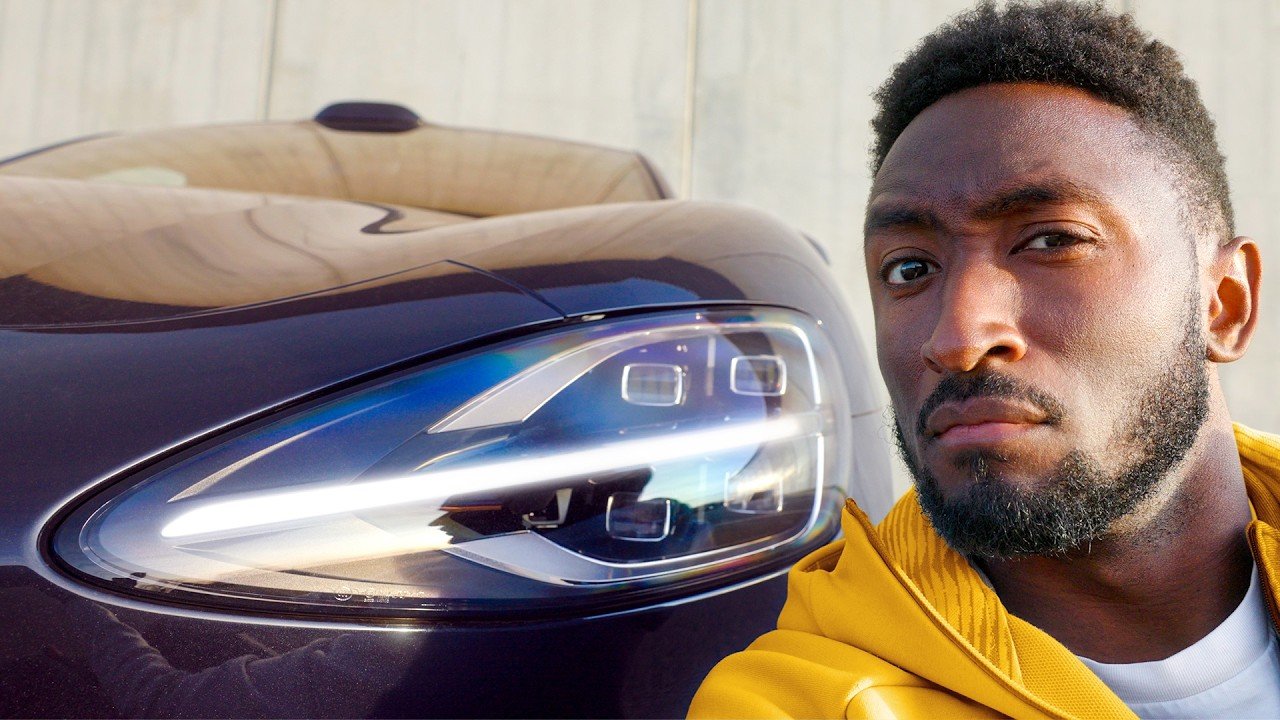
The drive mode knob sits just below the center console, and when Marques Brownlee rotated it one notch to the right, everything on the display turned red. That single click – from comfort to sport – is where the Xiaomi SU7 Max starts to stop making sense at its price point. After two weeks of daily driving, Brownlee came away with a question that kept getting harder to dismiss: how does a $42,000 car feel like it costs $75,000?
What a smartphone company did that car companies haven’t
The Xiaomi SU7 Max is built by the same company that makes tablets, robot vacuums, and smartphones across China. That background turns out to matter enormously inside the cabin. The 16-inch center display runs software that Brownlee described as feeling like a preview of what an Apple car might have delivered – smooth, tightly integrated, and aware of its own ecosystem. Text messages, map directions, and wireless screen mirroring all sync from a paired Xiaomi phone. For everyone else, there is also wireless Apple CarPlay, running on what Brownlee called the biggest and best window for CarPlay he has seen in any car.
One software detail stood out above everything else. When navigation instructions are active and music is playing, the SU7 Max separates the voice prompt to a single speaker in the driver’s headrest – leaving every other speaker in the cabin untouched. The music never drops for passengers. The bass never cuts out mid-song. Brownlee flagged it as his favorite software feature he had encountered in any car in recent memory. It is a small thing that reveals a larger philosophy: the people who built this car also live with phones all day and apparently found the usual interruption just as annoying as everyone else.
The modular interior adds another layer that has no real comparison elsewhere. Hidden mounting points around the cabin accept accessories from Xiaomi’s own lineup – a secondary speedometer display, a magnetic phone mount, a powered USB hub that passes charge through to rear passengers, high-quality microphones for karaoke use, and even long-range walkie-talkies. Each piece snaps on or off. The interior can be stripped back to near-minimalism or built out with hardware. No other car currently offers that kind of owner-controlled layout flexibility, according to Brownlee’s assessment across years of car reviews.
The specs that make a $55,000 competitor nervous
On paper, the SU7 Max carries a 101 kWh battery, dual motors, all-wheel drive, 673 horsepower, and a stated range of 320 miles. Those numbers sit at roughly the same level as a Tesla Model 3 Performance, which currently retails around $55,000 in the United States, according to Brownlee’s comparison. The SU7 Max lists at approximately 299,000 Chinese yuan, converting to around $42,000 USD at current rates.
In comfort mode, the air suspension absorbs road imperfections at a level Brownlee compared directly to Lucid vehicles – cars that start well above $70,000. Noise isolation inside the cabin is significant. Wind intrusion is minimal. Motor noise does not register. Active noise cancellation layers on top of that baseline. The result, Brownlee said, is a car that feels serene in a way that has nothing to do with marketing and everything to do with how tightly it was assembled.
Sport Plus mode changes the character entirely. The accelerator response sharpens, steering weight increases, and a G-force meter appears on the display. A dedicated boost button pulls all available power at once. Zero to 60 arrives in under three seconds – 2.5 seconds in full performance mode. Brownlee placed the handling feel close to a Tesla Model 3 Performance or a BMW i4, acknowledging it does not reach Porsche Taycan levels of dynamic sharpness but sits one step below that benchmark. For a car at $42,000, that positioning is unusual.
The seats carry active bolsters that tighten against the driver through corners – a feature most commonly associated with high-end Mercedes-AMG G-Wagen variants. The headliner is Alcantara throughout. Twenty-five speakers handle audio, with ambient lighting that pulses to the bass of whatever is playing and shifts color to match the album art of the current track. The rear passengers have Xiaomi tablets built into the seat backs. Two 50-watt air-cooled wireless chargers sit in the front console. Brownlee noted that before he had even driven the car, the interior alone felt like a $60,000 to $65,000 product.
The reason this particular car isn’t parked in American driveways yet
The Xiaomi SU7 Max is not available for sale in the United States. The barrier is not technological. Brownlee was direct on this point: the car contains no impossible-to-replicate battery chemistry or proprietary components. It is built from conventional parts assembled with unusual cohesion – great software, solid build quality, strong range, and a genuinely capable drive, all present at once. That combination is rare at any price point. The reason it stays out of the US market comes down to tariffs, import restrictions, and trade policy that Brownlee described as highly variable and potentially permanent for this market.
Europe is a different calculation. Xiaomi has indicated the SU7 could reach European markets by 2027, according to Brownlee’s reporting. He stated plainly that European competitors are in a difficult position if that timeline holds. The competitive pressure, he argued, ultimately benefits every buyer – it pushes every automaker to close the gap between what a car costs and what it actually delivers.
Xiaomi’s full self-driving system – branded as Pilot Pro and Pilot Max in China – operates through a LiDAR unit mounted on the roof. Brownlee tested it on smaller single-lane roads in the United States, where it was not designed to operate, and reported no unsettling behavior. Obstacle avoidance performed without incident. He noted that performance in China, on supported roads, would almost certainly be stronger.
The boost button getting pressed on a road it was never designed for
Somewhere on a smaller American road, Brownlee pressed the drive mode button and the SU7 Max filled its center display with a full-screen power graphic. All 673 horsepower loaded up. The car – a four-door sedan that looks from the outside like a composed, purple-tinged sport coupe – launched forward on roads it was never mapped for, in a country where it cannot legally be sold.
That drive mode knob, rotating one click to the right and turning everything red, is where the SU7 Max’s strangeness becomes most legible. A car built by a company that makes robot vacuums, sitting on American roads for a two-week test, asking a reasonable question about whether $42,000 should always feel the way it does.
Source: Watch original
This article was reported in June 2026.
OHN Editorial Note: This article is based on publicly available sources. If you spot an error or have updated information, contact us at editorial@onlyhappynews.com. We correct mistakes promptly.