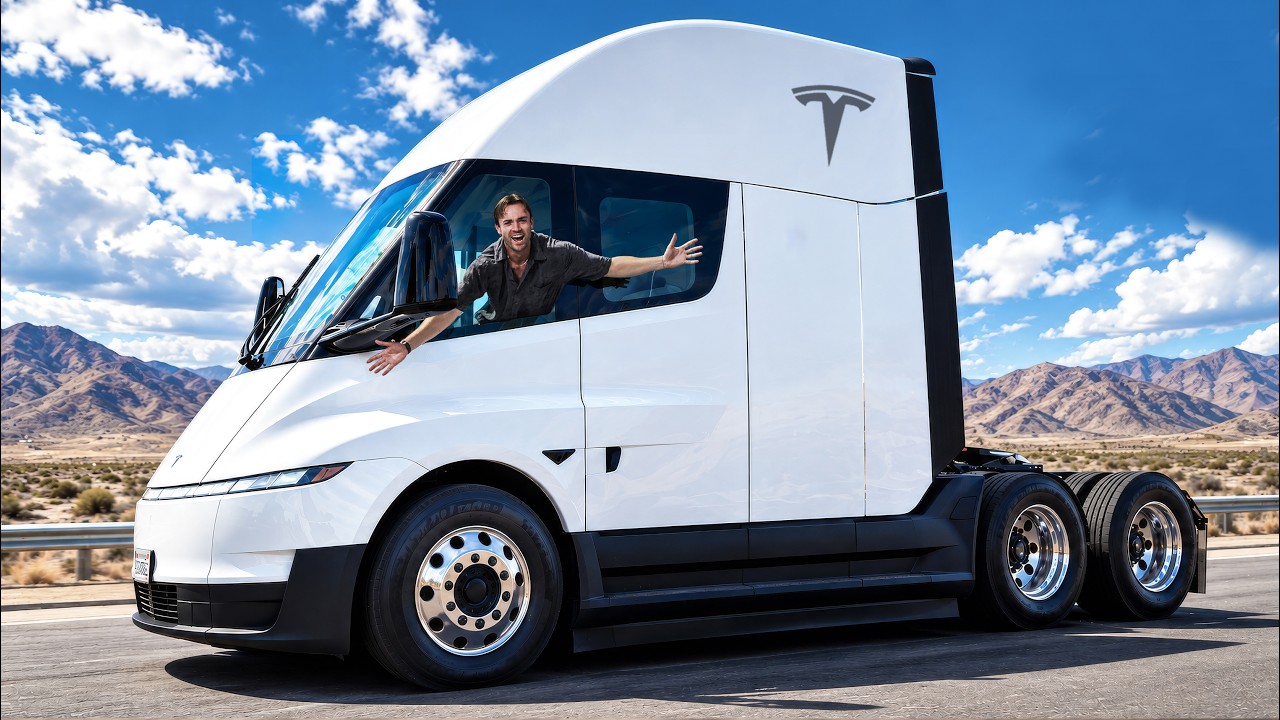
The Tesla Semi sits outside a brand-new 1.7-million-square-foot Gigafactory in Nevada, finished, road-legal, and pulling a fully loaded trailer with what its engineers describe as complete effortlessness. Eight years after Elon Musk first put it on a stage, the truck that many dismissed as vaporware has arrived as a production vehicle, and the question it has to answer is no longer whether it exists but whether it actually works. Jack Scarlet of Top Gear Tech made the trip to Nevada to find out, and what he found was a piece of engineering that changed his mind.
Why making an electric lorry is so much harder than it sounds
The fundamental problem with electric freight is weight, and the numbers are brutal. Storing the energy equivalent of one kilogram of diesel requires roughly 40 kilograms of lithium-ion battery. In a passenger car that is inconvenient. In a vehicle whose entire purpose is to carry cargo, it is potentially fatal to the business case. Pile in enough battery to match a diesel truck’s range and you have no payload capacity left. Scale back the battery and you have a truck that needs more charging stops, and in haulage, time is money.
Tesla’s answer is to chase efficiency at every level, starting with aerodynamics. Without a trailer attached, the Semi has a lower drag coefficient than a Bugatti Chiron. The production version is 3% more aerodynamic than the prototypes, partly because the tall headlight was replaced with a low light bar that freed up space for an air vent that guides airflow over the front wheels. The motor arrangement does similar work. Three motors are fitted: two on one axle for torque during acceleration and hill climbing, and one on a separate axle tuned purely for efficiency at cruising speed. When the truck reaches highway pace, the torque axle decouples entirely and the efficiency motor takes over. The result is a consumption figure of 1.7 kilowatt-hours per mile, which means the Semi uses three times less energy than a comparable diesel truck and is only seven times less efficient than a Tesla Model Y despite weighing 20 times more.
Range on the standard-range version is 325 miles. The long-range reaches 500 miles. Those numbers were chosen deliberately to mirror the maximum distances drivers are legally permitted to cover in a single stint before a mandated rest break in Europe and the United States respectively. During that break, a 30-minute charge session restores 60% of the battery.
The factory and the truck were designed as a single object
The Gigafactory itself cost $3.6 billion and is designed to produce 1,000 Semis every week, scaling to 50,000 per year. Rod, the plant manager, runs the floor on a philosophy he shared with Scarlet directly: ‘Don’t find me a dollar, find me a hundred cents.’ Every small saving compounds. A machine that attaches all ten lug nuts to a wheel simultaneously saves a handful of seconds per truck. Across years of production, the difference is significant.
The factory has no paint shop. The hoods are powder-coated rather than liquid-painted, which requires less capital, less floor space, and produces fewer volatile organic compounds. The cab is assembled with a large opening at the rear rather than loading components through the doors or the front, which means workers can walk upright inside the cab and bring in large assemblies without geometric constraints. The seat is Tesla’s own design and includes both heating and cooling, because a driver using a heated or cooled seat is less likely to run the cabin heater or air conditioning, which consume far more energy.
The battery packs are cube-shaped rather than the flat underfloor format common in electric cars. The more compact geometry holds heat better, reducing energy spent warming the battery in cold weather. The cells are 4680-format cylindrical units, with a cooling belt threaded through the middle. The long-range version is literally the standard truck with a third battery pack slotted in alongside the other two, making both variants straightforward to build on the same line.
Out on the road, the central driving position removes what Scarlet called a Range Rover-sized blind spot present in American long-nosed trucks. The windscreen is vast. At a 3% grade, where a diesel truck tops out at 50 mph, the Semi holds 65 mph. Regenerative braking handles most highway descents without touching the friction brakes at all, extending brake service intervals and cutting operating costs further.
On a cost-per-mile basis in California, where electricity runs around 20 cents per kilowatt-hour, the Semi costs approximately 34 cents per mile to run. A diesel truck at $7 per gallon achieving 7 miles per gallon costs around $1 per mile. The saving is roughly 65 cents per mile, which across 100,000 miles of annual driving amounts to $65,000 a year in fuel alone.
The sun visor that is 6’6″ of headroom
Scarlet, who stands 6 feet 6 inches tall, paused mid-tour to note that he could stand upright in the back of the cab without stooping. He declared it the best car of all time on the spot, then caught himself and remembered he was in a truck.
The Semi that rolled out of the Nevada Gigafactory with a fully loaded trailer behind it is the same vehicle that was promised eight years ago, finished and refined by 17 million miles of real-world testing. Whether the haulage industry moves quickly or slowly toward it, the engineering case for why it should has already been made.