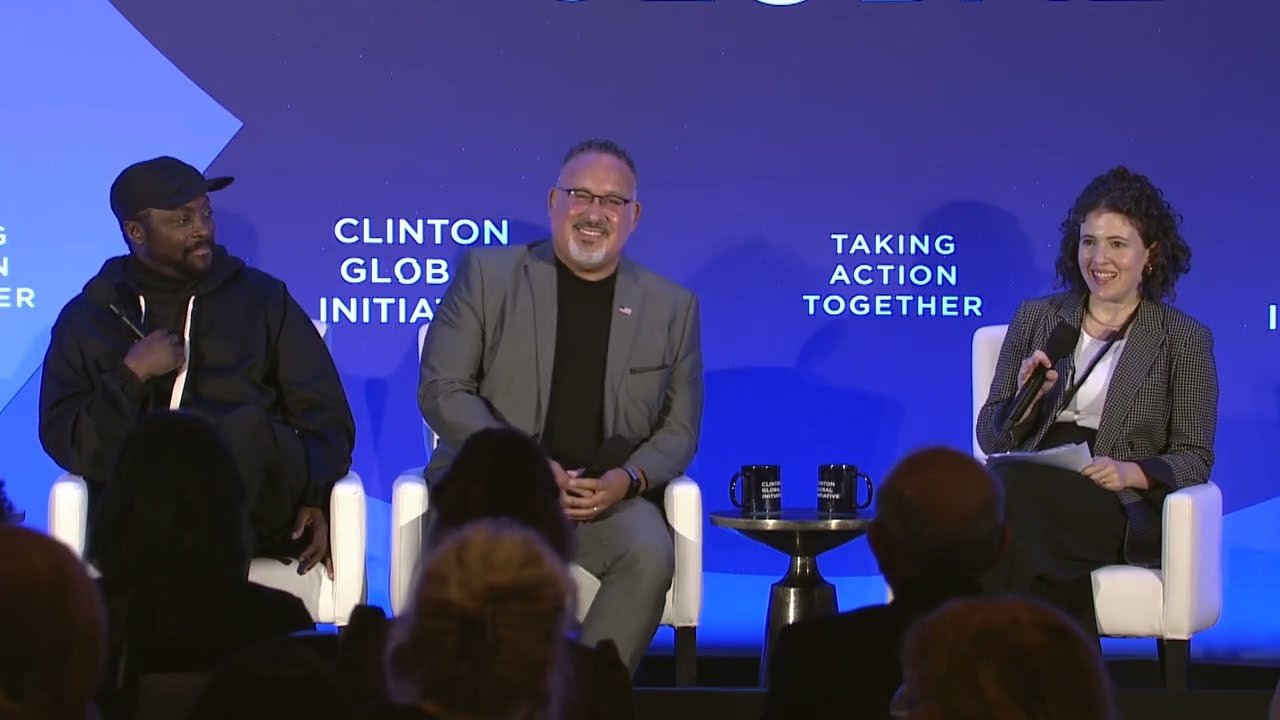
Will.i.am laid it out with the kind of specificity that stops a room cold: every high school in America has a football field, and exactly one organization benefits from that investment. The NFL. One gender dominates it. One career path flows from it. Yet the same schools that pour concrete and lights and budget into those fields cannot manage a single robotics program. That gap, he argued at a Clinton Global Initiative conversation moderated by Time Magazine senior correspondent Charlotte Alter, is not an oversight. It is a policy choice. And Generation Z is the one paying for it.
The case for putting robotics in every school, fast
The i.am.angel Foundation has been running Project-based learning in East Los Angeles since 2008, working with low-income, working-class, and immigrant students through robotics clubs, STEAM programs, and mentors from Boeing and NASA. Will.i.am described the change he witnessed in his own neighborhood before and after those programs arrived, and the framework the foundation uses for it: a concept he called ‘coopertition,’ where students cooperate and compete at the same time. ‘Project-based learning is really what the world is truly about,’ he said. ‘You have something you are interested in, there is a project, you learn about it, and your passion and imagination will thrive.’
His ask to the room was concrete. A program called FIRST, which runs robotics competitions from elementary school through high school, including FIRST Lego League for younger students, should be placed in every school in America. He had just learned that morning from Dean Kamen, the American inventor he called a mentor and a superhero, that New Hampshire is already moving in that direction, committing every school to FIRST participation. Will.i.am wants that model replicated across every state, and he named semiconductors as the reason the urgency is not optional: the United States lacks the trained workforce to manufacture its own chips, and a 30-year plan starts with elementary school.
What the Department of Education is already building toward
Secretary of Education Miguel Cardona, who described himself as a first-generation college student, arrived at the same destination from a different direction. The Department recently launched the Career Z Challenge, committing $2.5 million to spark innovation where high schools and two-year colleges talk directly to industry partners about what skills they actually need. Before the CGI session, Cardona had been meeting with Google’s CEO to secure commitments for internships and direct pathways into the workforce from community colleges and high schools. He was direct about the pre-pandemic baseline: ‘If we go back to the school systems that we had in 2019, we are failing our kids.’
Cardona also pushed back hard on the four-year-college-or-bust mentality, pointing to $117 billion in debt relief provided to over 3.4 million Americans, the SAVE income-driven repayment plan, and public service loan forgiveness after 10 years as evidence that the administration is not waiting on the courts. The Supreme Court’s decisions on affirmative action and student debt relief, he said plainly, were wrong. A forthcoming report from college presidents and students is expected to lay out new pathways to campus diversity.
Will.i.am took the affordability question somewhere unexpected. He pulled up a live AI demonstration mid-panel and asked it to explain quantum entanglement in the style of an NWA rap, then from the perspective of selling sneakers. The AI complied, verse by verse. His point was not the novelty. It was that a student who learns differently, who has been medicated to conform to a single teaching style, now has access to a professor who will explain any concept in the exact register they need. ‘We are going to enter forever learning,’ he said, ‘where educational systems will understand a person’s limitations.’
The scoreboard nobody is tracking
The NFL holds a televised draft. Every player’s destination is announced. Their future employer is celebrated on national television. When a student graduates from MIT or Brown or Stanford and goes to work at Google, Will.i.am noted, nobody calls it a draft. Nobody broadcasts it. ‘Why is it that we don’t celebrate problem solvers but celebrate problem makers?’ The question sat in the room without a clean answer.
Back in East Los Angeles, the headquarters of the i.am.angel Foundation sits directly across the street from the Hollenbeck police station where his aunt has worked as a dispatcher for years. His grandmother worked at City of Hope. His uncle coached basketball to keep kids off the street. Purpose, he said, was never something he discovered. It was the family business. Music was just the vehicle that let him travel far enough to meet the people who could bring better tools home.