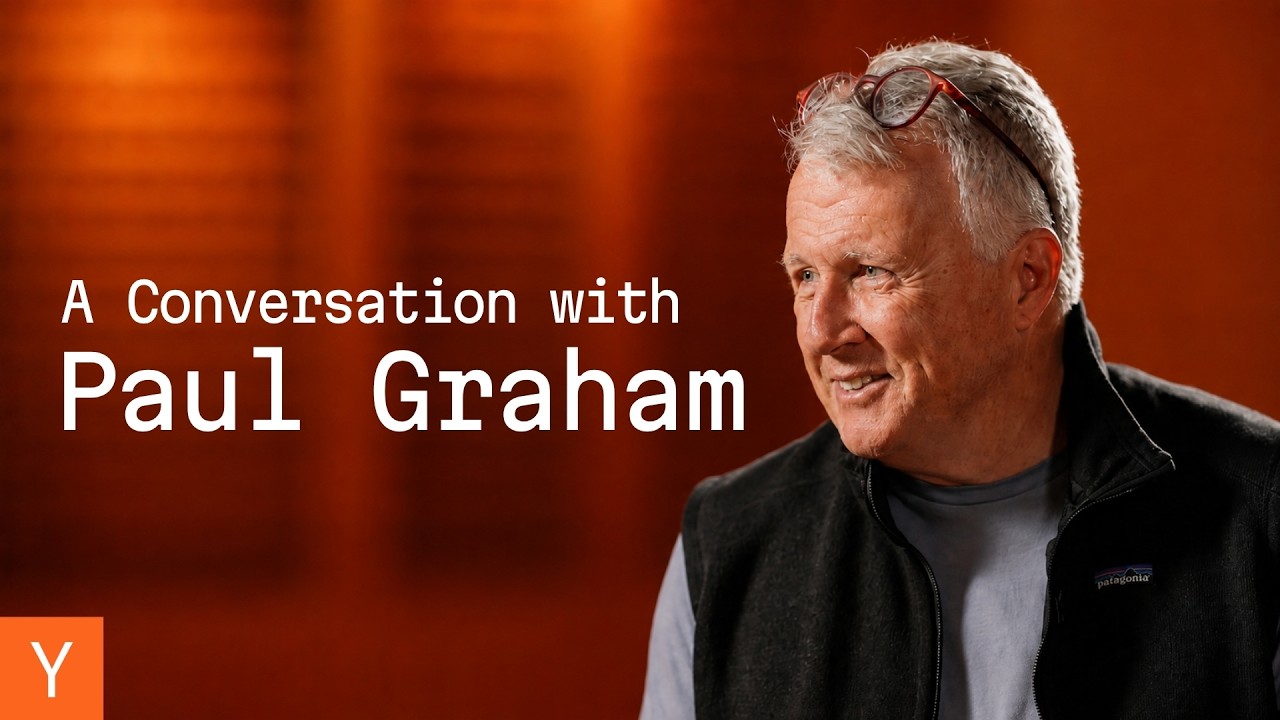
Paul Graham was sitting at Y Combinator‘s original Mountain View offices, a few hours away from delivering a talk he had given 46 times before, and he was typing it fresh into a blank text file. That detail matters because it captures something Graham has spent two decades trying to explain: the fundamentals of building a company almost never change, and yet every batch forces him to think through them again from scratch. For anyone betting on a startup right now, that consistency is either reassuring or terrifying, depending on where you are in the journey.
The conversation started with a provocation. Graham had recently written that the startups YC funds today are far more serious than the ones from the so-called good old days. The comparison was pointed. Early batches produced Reddit, which he described as ‘valuable as it is, not exactly intercontinental ballistic cargo.’ The current batch includes a company focused on curing cancer through what Graham called ‘the death of a thousand cuts,’ doing on-demand personalized research for patients. That same company had already worked informally with Sid Sidarth of GitLab, who approached his own cancer diagnosis the way he would a startup. Graham remembered thinking afterward that someone should build a company to do for everyone what Sid did for himself. The people who actually did it for Sid are now the founders.
Why ambition looks like fear, not confidence
Graham is often asked when he figured out that founders need genuine ambition, not just technical skill. His answer is that he already knew it before YC launched, because he had done a startup himself and understood what the obstacles actually feel like. ‘Being beautiful is not enough,’ he said plainly. ‘The obstacles are too fearsome for mere beautifulness to do it.’
What surprised him, though, is what ambition feels like from the inside. It rarely resembles the desire to become a billionaire. ‘You know what actually motivates founders day-to-day? The fear of failure.’ The server crashing at 2 a.m. is not a moment where someone thinks about their future net worth. They think about the server. Graham has occasionally been the first person to do the math for a founder and tell them, based on their last round valuation, that they are technically a billionaire. The reaction, he said, is usually genuine surprise.
Formidable founders, in his framing, are simply people who get what they want. That is the whole test. If an investor owns a share of a company and the founder gets what they want, the investor gets what they want. The alignment is automatic.
What AI actually changed, and what it did not
Graham studied artificial intelligence in the 1980s, a version he described as ‘a joke’ that would never have worked. The theoretical assumption back then was that progress would move from simple to complex: start with a perfect simulation of a fly, work up through mice and cats to eventually reach human-level intelligence. What arrived instead was the opposite. The first versions of large language models were, in his words, ‘like an undergrad trying to his way through a paper.’ Full human capability, but unreliable. ‘Nobody expected when the first plausible AI turned up, it would be like a bullshitting undergraduate,’ he said. The finish line that researchers imagined as a sharp horizon turned out to have width. Some capabilities are well past it; others, like knowing when a restaurant is open, are still nowhere near it. Graham calls this the jagged frontier.
For startups, though, the key metric has not moved. The best predictor of success is still how fast a team ships new work. AI tools are now part of every batch, and the bills are new: some companies are paying tens of thousands of dollars a day in compute costs, something that simply did not exist when salaries were the only expense that mattered. But the startups that are not shipping fast enough in this batch, Graham said, are not shipping fast enough for the same reason founders never did: they have not figured out what to build next.
The blank text file every batch
Graham opened a text file a few hours before this talk and started typing.
Forty-seven batches in, the document still starts empty. The founders who will build the next trillion-dollar company are out there, Graham said, and they look exactly like the ones from 20 years ago. What they are working on is probably promising, but the idea is secondary. The founders come first, and the company follows from them.
 Wake up to Only Happy News!