
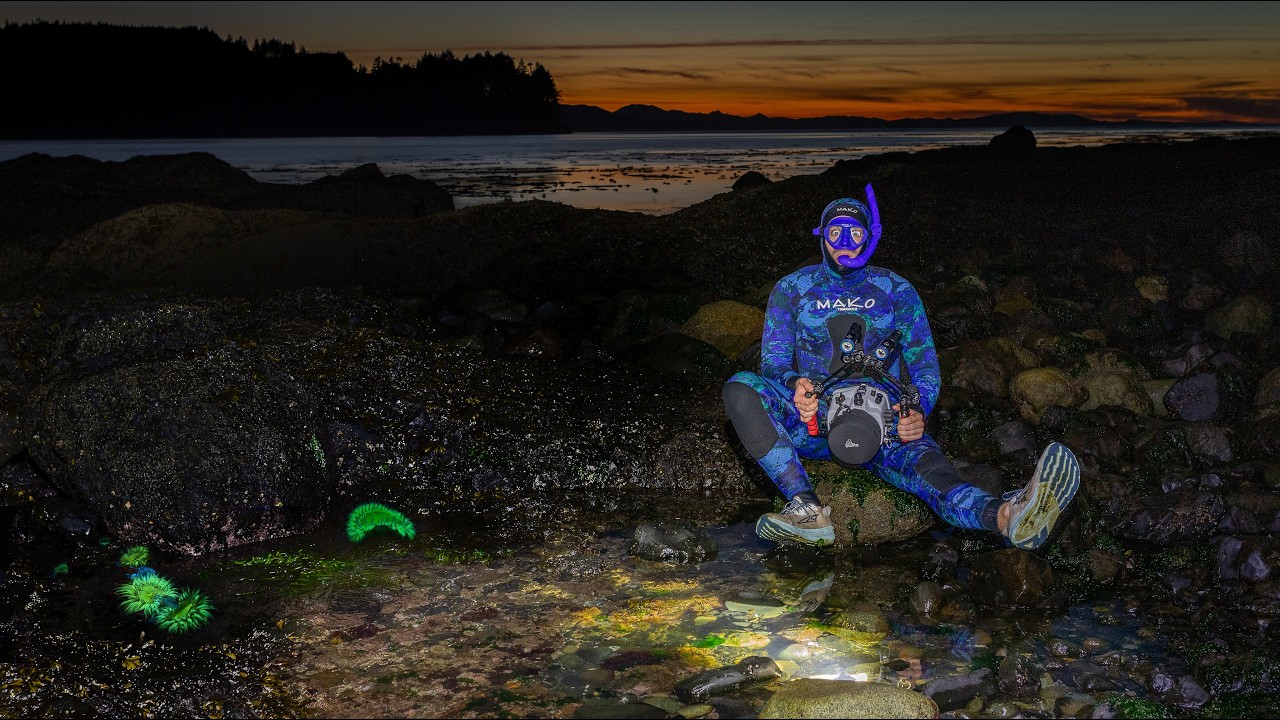
On the northern tip of the Olympic Peninsula, where Washington State meets the Pacific, Joseph Ricketts squeezed into an open-cell wetsuit at 40-something degrees Fahrenheit, lathered on seaweed-based lubricant, and poured warm water he had brought from home over the neoprene just to make the process bearable. That detail matters, because the entire night snorkel that followed ran on the same logic: improvised, unglamorous, and absolutely worth it. What nobody on shore could have predicted was that a yellow filter cut from a piece of plastic gel with scissors would eventually reveal a glowing giant green anemone pulsing in the dark of the Pacific Northwest surf.
Tiny tide pools, surprisingly large ambitions
Ricketts had expected the tide pools to be considerably deeper. They were not. Working the rocky intertidal zone at low tide, he quickly accepted the constraints and stuck his face into the shallowest of pools, pulling the camera out between dips so he could fit them both. The compromise paid off immediately. A juvenile tide pool sculpin, barely an inch long and draped in sea lettuce green, materialized out of the algae canopy. Nearby, a second sculpin had flattened itself against the rock so perfectly that it nearly vanished. Chitons clung motionless to the stones in the same ancient posture they have held for millions of years, while Pacific hairy hermit crabs patrolled the bottom on chessboard-patterned legs, aggressively inspecting living snails for shell availability. As Ricketts put it: ‘The gastropod disrespect is crazy. But that’s hermit crabs, baby.’
Aggregating anemones appeared in tight colonies along the pool margins. This species reproduces asexually, splitting and cloning itself until a single individual becomes a genetically identical crowd. A strand of bull kelp prompted a detour into enthusiasm: Ricketts noted that people make pickles from it and that he has personally tried them.
Three biomes in the dark, one very good fish
When the pools gave way to open surf, the Salish Sea announced itself with what Ricketts described as frigid fists. He broke the deeper water into three biomes and worked through them methodically. On the sandy flats, a pair of graceful crabs were locked in a pre-mating grasp, the larger male holding the female until she molts. A translucent shrimp tumbled through the surge, fighting the current. Partially buried in the sand, a great sculpin lay in ambush, its comically oversized head proportioned for gulping down unsuspecting fish whole. Adults of this species can reach nearly 3 feet long; Ricketts believed this individual was a juvenile at around 6 inches.
The shallow kelp beds produced a school of what appeared to be juvenile Pacific herring, a tubesnout fish that looked, in Ricketts’ words, like it was made by ‘slapping some googly eyes on a syringe,’ and a graceful kelp crab wearing a small piece of sea lettuce on its shell like a hat. A cross jellyfish drifted through the vegetation wall. Back at the rocky shoreline, Pacific purple sea urchins filled every crack, and Ricketts found Urtibrina rimicola, a newly described anemone species that does not yet have a common name.
And the tide pool sculpin turned out to have one more trait worth knowing: they can find their way back to their original pool after being moved more than a football field away.
The monocle that worked
For the fluorescent pass, Ricketts rigged his dive lights to their blue setting, taped a yellow gel filter cut with scissors behind the camera lens, and wedged a spare filter piece into his mask as a monocle. It was, by his own description, a bootleg setup. When he closed his left eye and looked through the yellow plastic, the aggregating anemones lit up. The cross jellyfish fluoresced faintly. The seagrass and kelp beds turned blood-red in the dark. And then, at the edge of visibility, a fully fluorescent giant green anemone appeared, glowing against the black water. The adjacent Urtibrina rimicola, by contrast, produced zero fluorescence. The reason these animals fluoresce is not fully settled, though it is thought to assist in visual communication between organisms and may offer some cellular protection in certain anemone species.
The piece of yellow plastic still tucked in the mask
A scrap of gel filter, hand-cut with scissors and jammed into a dive mask like a monocle, sitting at the edge of the surf on the Olympic Peninsula.
Ricketts had never been to this stretch of coast before and had never tried the fluorescent setup in open water at night. The wetsuit warmed up. The tide pools, shallow as they were, delivered. And the anemone glowed right on cue.
 Wake up to Only Happy News!