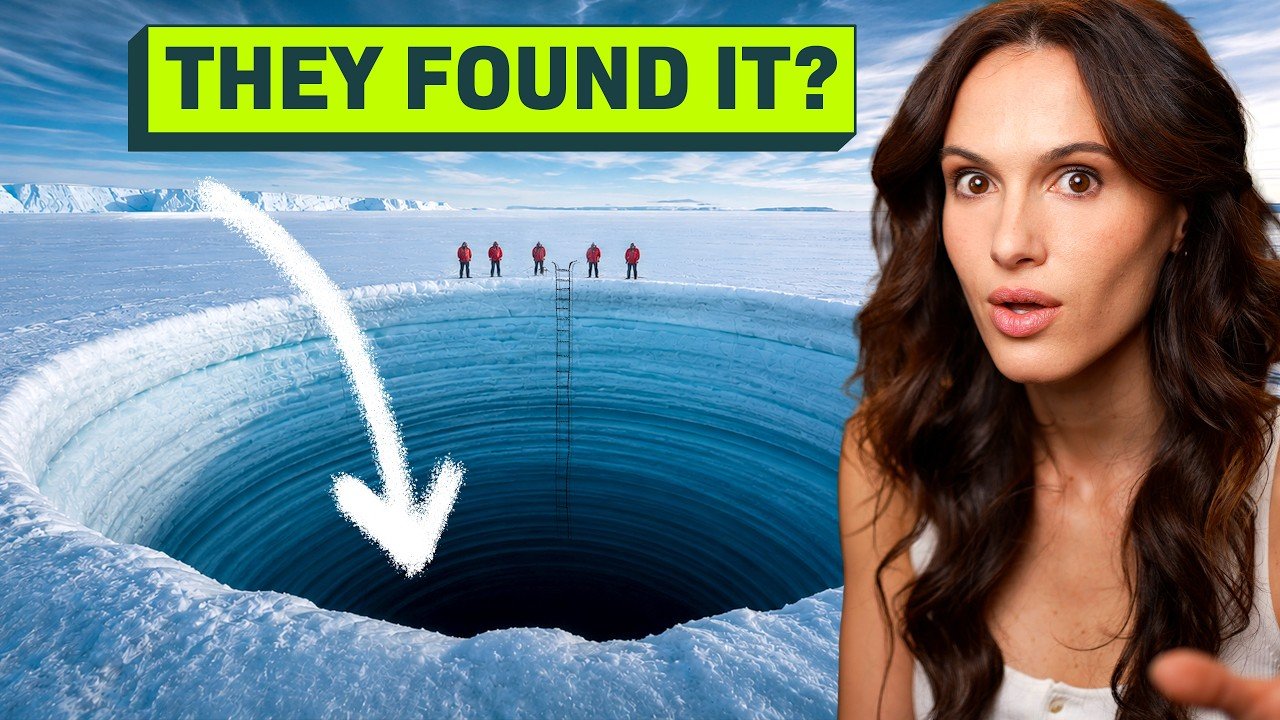
In 1970, a group of Soviet scientists began drilling into the Antarctic ice sheet. For 28 years, they kept going – nearly 4,000 meters straight down – until they hit something nobody expected: a liquid lake that had been completely sealed off from the rest of the world for 15 million years. That discovery, and everything that followed it, reshaped what scientists thought they knew about Earth’s most remote continent.
Host Cleo Abram traveled to Antarctica with the White Desert Foundation’s Science Week to trace the full arc of that story – from the physics of the ice itself, to the ecosystems thriving in the dark beneath it, to what it all means for the search for life beyond Earth.
A Continent Hiding More Than Ice
The ice sheet over Antarctica is not what most people picture. At its thickest, it reaches nearly the height of Mount Kilimanjaro. To match that elevation, you would need to stack the world’s tallest building six times. And it is not a uniform slab – it moves, stretches, and fractures. Abram descended into a crevasse on the surface, a gap in the ice deep enough that falling into one would be fatal, formed when the sheet stretches faster than it can hold together.
Dr. Steven Chow, a biologist specializing in Antarctic life who led the expedition, walked Abram through what lies within the ice itself. Drilling an ice core reveals a physical archive of Earth’s atmosphere – winter and summer layers stacked like tree rings, volcanic ash lines from eruptions tens of thousands of years ago, and trapped air bubbles from eras as far back as the extinction of Neanderthals. A European research team has already pulled a core dating back 1.3 million years – the longest climate record ever extracted from ice. Analysis is expected within a couple of years.
Below the archive layers, something changes. At around 3,500 meters deep, the ice becomes perfectly clear – no bubbles, no dust. That clarity is the first physical sign of what sits underneath: a lake.
Three Countries, Three Ancient Lakes, One Major Discovery
The lake beneath the Soviet drill site is called Lake Vostok. It is comparable in size to Lake Ontario and ranks sixth in the world by volume. It stays liquid because 3,500 meters of ice above it acts as a thermal blanket, trapping heat from Earth’s core – and because the pressure at that depth, 350 times greater than sea level, drops the freezing point of water significantly.
After radar-equipped planes crisscrossed the continent filling in maps of what lay beneath, scientists catalogued not just one or two lakes but hundreds. Dr. Helen Fricker was the first to notice that parts of the ice sheet were physically lifting and dropping by nearly 10 meters – entire active lakes filling and draining into one another through a connected plumbing system of subglacial rivers.
That scale prompted a coordinated push: Russia would drill into Lake Vostok, Britain into Lake Ellsworth, and the United States into Lake Whillans. The Russian attempt broke through – but the water that shot 30 meters up the drill hole mixed with the kerosene used as drilling fluid, and the international science community largely rejected the contaminated bacterial results that followed.
The British team, drilling with decontaminated hot water rather than chemical fluid, ran out of fuel before reaching their target. That left the American team. When their drill finally broke into Lake Whillans, the cheers were audible across the camp. Scientist John Priscu, one of the first researchers to study Lake Vostok and a key figure in the Whillans effort, described the moment as goosebumps-worthy. The sample they retrieved contained a full microbial ecosystem – colonies of bacteria and tiny organisms thriving with no sunlight, no connection to the surface world.
In 2018, the team returned and sampled sediment from the same region. The research Priscu is preparing to publish points toward organisms that appear genuinely distinct from anything found elsewhere on Earth – including new types of bacterial viruses unlike those catalogued anywhere else.
The Industry Ripple Effect
The drilling technology, contamination protocols, and remote-sensing methods developed to explore these subglacial lakes are not staying in Antarctica. Scientists working on these projects point directly to the icy moons of Jupiter and Saturn – Europa in particular – as the next logical targets. The same pressurized hot-water drilling rigs, the same UV decontamination systems, and the same under-ice camera equipment would apply. Finding a full microbial ecosystem under kilometers of Antarctic ice, in cold and darkness and total isolation, has shifted the probability estimate for extraterrestrial life among many researchers. Priscu’s answer when asked whether life exists on Europa was unambiguous: yes.
Hundreds of Antarctic subglacial lakes remain untouched. Scientists consider large animal life in those lakes unlikely – but what microbial life exists in them, and how 15 million years of isolated evolution has shaped it, is still an open question.
The 28-year Soviet drill that hit liquid water in the dark is where this story started. The organisms found alive in that darkness – cut off from sunlight, from the surface, from every other living system on the planet for longer than modern humans have existed – are where it currently stands.