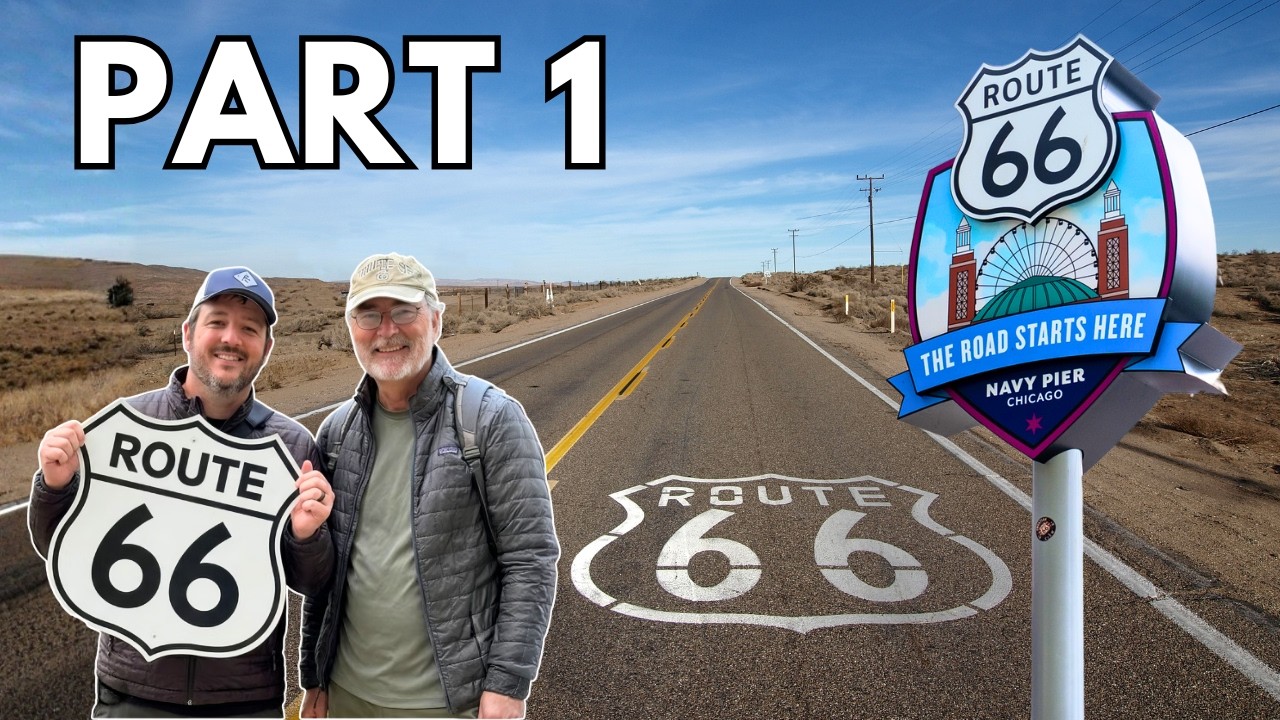
At the corner of Michigan and Adams in Chicago, a father and son stood at the official start of Route 66 on a morning in May and said the only thing left to say: ‘Route 66 journey starts now.’ For a road celebrating its centennial, the timing felt right. For the two of them, it felt like coming home. The first time Through My Lens covered all 2,400 miles from Chicago to Los Angeles, they found a road that was still waking up. The second time, they found one that had been busy while they were gone.
A road that got busy while nobody was watching
The journey opened, as it should, at Lou Mitchell’s, a diner that has been feeding travelers at the start of the Mother Road since 1923, three years before Route 66 even existed. It has served US presidents from Reagan to Obama, and it still sends out a doughnut hole and an orange slice before the meal. Thick grilled French toast arrived within seven minutes of sitting down. From there the drive west began in earnest, stopping at the Gemini Giant in Wilmington, a fiberglass astronaut originally bought in 1965 by a local restaurant to advertise hot dogs and ice cream. He has been bought, preserved, and given his own park since the restaurant closed in 2022, and he looks, in the words of the trip, ‘way better than last time.’
In Joliet, the mood shifted at the old prison, which opened in 1858, held its first 53 prisoners under notoriously bad conditions, and finally closed in 2002. A third visit to a two-cell jail in Gardner turned up a notebook with a Paul McCartney signature that was stolen two days after he signed it. Further south in Pontiac, the Route 66 Hall of Fame holds the VW van belonging to Bob Waldmire, the artist who spent decades hand-drawing maps and illustrations of every diner and roadside oddity on the road. He is also the man who inspired the character Fillmore in the Cars film. His father, Ed Waldmire, invented the corn dog.
Springfield, the room where Route 66 got its name
By the time the drive reached Springfield, Illinois, a sculpture called the Ghost of the Colonial Hotel marked the parking lot where the Colonial Hotel once stood. That is the spot where a telegraph was sent choosing the name Route 66 over Route 62. Springfield leaned into that history hard for the centennial, with welcome centers, new sculptures, and a birthplace sign in the town square that had fireworks built into its design.
Day three brought the trip’s most memorable guest. A 94-year-old grandmother joined the drive through St. Louis, beginning at a cathedral whose ceiling mosaic covers 80,000 square feet and contains over 41 million individually hand-placed pieces of glass. Lunch followed on the Hill, the Italian neighborhood where immigrants arrived in the 1880s to work the clay mines. At Ted Drews, the frozen custard institution open since 1930, she tried a root beer float and delivered an on-camera assessment of her own work ethic: ‘I’ll say anything for money.’
The world’s largest ketchup bottle, standing in Collinsville, turned out to be a working water tower built in 1949 for a ketchup plant that later closed. A preservation group saved it from demolition. The Chain of Rocks Bridge, entering Missouri, still carries the 22-degree bend forced by the bedrock beneath it, and the Route 66 sign in the middle of the bridge is still there.
The coconut cream pie that’s been 40 years in the making
At Ranks Market in Lebanon, Missouri, a woman who has been making coconut cream pie for 40 years sat down with the travelers and told them simply: ‘This is the best coconut cream pie you will ever have.’ The barbecue smelled good too, but they had already eaten.
The Wagon Wheel Motel in Cuba, Missouri, opened in the 1930s and has never once closed. It is the oldest continuously operated hotel on the route. Nights there ended outside under the neon, just watching the sign come on. Maramec Caverns outside of Sullivan drew the trip underground, through a tour that follows a path reportedly used by Jesse James as an escape route, though as the guide notes, historians still argue about whether he was actually there.
By day four the drive was approaching Springfield, Missouri, with a stop at Fantastic Caverns, the only drive-through cave in North America where visitors never leave their seat. The tour costs $36, runs about 45 minutes, covers roughly a mile of cave, and stays at a steady 55 to 60 degrees year round. The neon sign outside had been knocked apart by a hailstorm a few weeks earlier. The other side was still lit.
Outside room 21 at the Wagon Wheel
A small metal chair and a round table sit outside room 21 at the Wagon Wheel Motel in Cuba, Missouri, positioned to face the neon sign and the parking lot and the road beyond it.
Route 66 in its centennial year is not the same road it was six years ago. The signs have multiplied, the service stations have been restored, new stops have opened, and old ones have been given parks and plaques and preservation groups. The corner of Michigan and Adams will still be there when the next person arrives with a doughnut hole in hand and 2,400 miles ahead of them.