Destin Sandlin walked up on a company in San Francisco with a tank of helium out front and admitted, on the spot, that he had not done his research on who they were. What he discovered inside WindBorne Systems turned out to be one of the more quietly consequential technologies in modern meteorology: a constellation of roughly 600 reusable, steerable weather balloons circling the globe at any given moment, each one making repeated vertical sweeps through the atmosphere for weeks or months at a stretch, feeding data into AI forecast models that are starting to outperform the physics equations meteorologists have trusted for decades.
How the balloon actually works up there
The hardware that WindBorne launches is deceptively humble-looking on the ground. The balloon itself, which the team calls the envelope, is a single long tube of plastic roughly five times thinner than a human hair, folded in half until launch. Beneath it hangs the main electronics unit, a solar-powered board tucked under a pyramid-shaped Mylar reflector the team calls the Luxor, designed to bounce infrared radiation from the Earth toward the lithium battery at its center, keeping it functional at temperatures that can drop to around negative 80 degrees Celsius. Dangling ten meters below that is the sensor payload, which the engineers call, without apology, the dangly.
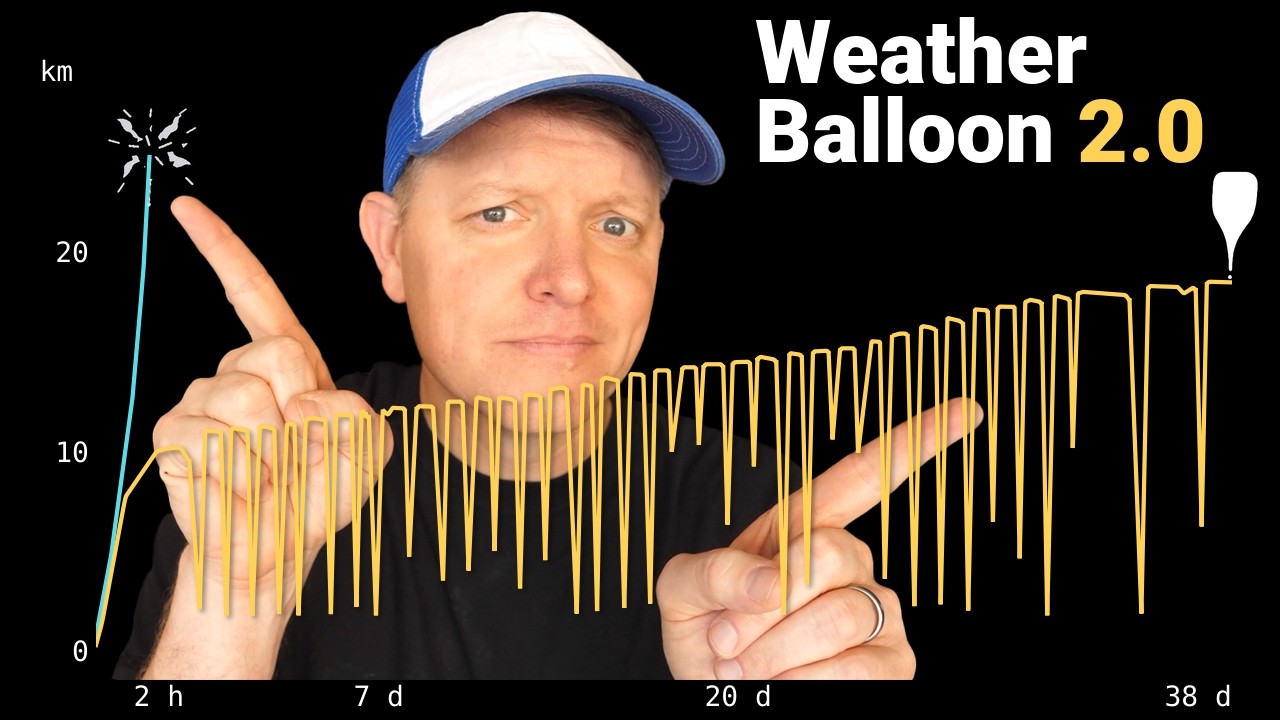
What separates a WindBorne balloon from a traditional radiosonde is the vent at the top of the envelope and a ballast system that drops sand. A standard weather balloon goes up until it pops, delivering one vertical profile of temperature, pressure, humidity, and wind data before it is gone. WindBorne’s balloon vents gas to descend, drops sand to ascend again, and repeats that cycle continuously, collecting what engineer Michal called ‘vertical profiles through the atmosphere’ over and over for the life of the flight. The record flight, affectionately named The Elder by the team, flew for just under a year.
CTO Andrey described why that vertical dimension matters so much: ‘If you are experienced in the field and you know what you’re looking at, you can look at one of those diagrams of temperature and moisture versus altitude and go, there’s a lot of convective available potential energy here, which are the conditions for getting convection.’ A single vertical sweep can tell a forecaster whether a thunderstorm is likely to form in the next twelve hours in a way that horizontal satellite data simply cannot.
Steering a balloon over Missouri on request
Flight controller Amy, who oversees the constellation, demonstrated something that reframes what a weather balloon even is. Asked whether a balloon could be directed over Missouri within an afternoon, she opened her laptop, identified a balloon already in the region, checked what she called the ‘cone of possibility’ at various altitudes, set a new altitude band between roughly five and fourteen kilometers, and queued the new flight plan. The balloon, designated 8680, began descending toward the wind layer that would carry it on course. Its predicted path and actual path later confirmed it arrived over Missouri that evening.
The balloons do not carry ADS-B transponders because the added weight would make them more dangerous to aircraft on impact. Instead, they ingest FlightAware ADS-B data via Iridium satellite and run Monte Carlo projections of uncertainty cones for both the balloon and any nearby aircraft, taking evasive altitude action if the probability of intersection crosses a threshold. When a balloon went dark after a 737 MAX reported an unidentified debris strike, the WindBorne team cross-referenced the incident, confirmed one of their balloons had disappeared from the constellation at that location and time, and cold-emailed a preliminary internal investigation to the NTSB by 6 a.m. Monday.
On the data side, meteorologist Larissa and AI researcher Anuj work in adjacent but complementary frameworks. Larissa steps a physics-based finite element model forward through time in increments as short as one second for high-resolution regional models. Anuj runs the same initial conditions through a transformer-based AI that compresses the 3D atmospheric grid into what he described as a latent space tensor of roughly a thousand dimensions, learning correlations from historical patterns the way a language model learns from text. As Larissa put it: ‘We’re nowhere close to physics models ever going away. They have to work together.’
The hat that arrives when you find one
Somewhere in the world, a WindBorne balloon carries a sticker in five languages that reads ‘Hi, I am a weather balloon.’ Scan the QR code, fill out a form with where you found it, and the company covers return shipping and sends swag.
The swag is a hat. It reads: ‘I found a weather balloon and all I got was this stupid hat.’ The hat exists because a person named Ellie, who handles that particular side of operations, thought it was the right call. She was correct.
 Wake up to Only Happy News!