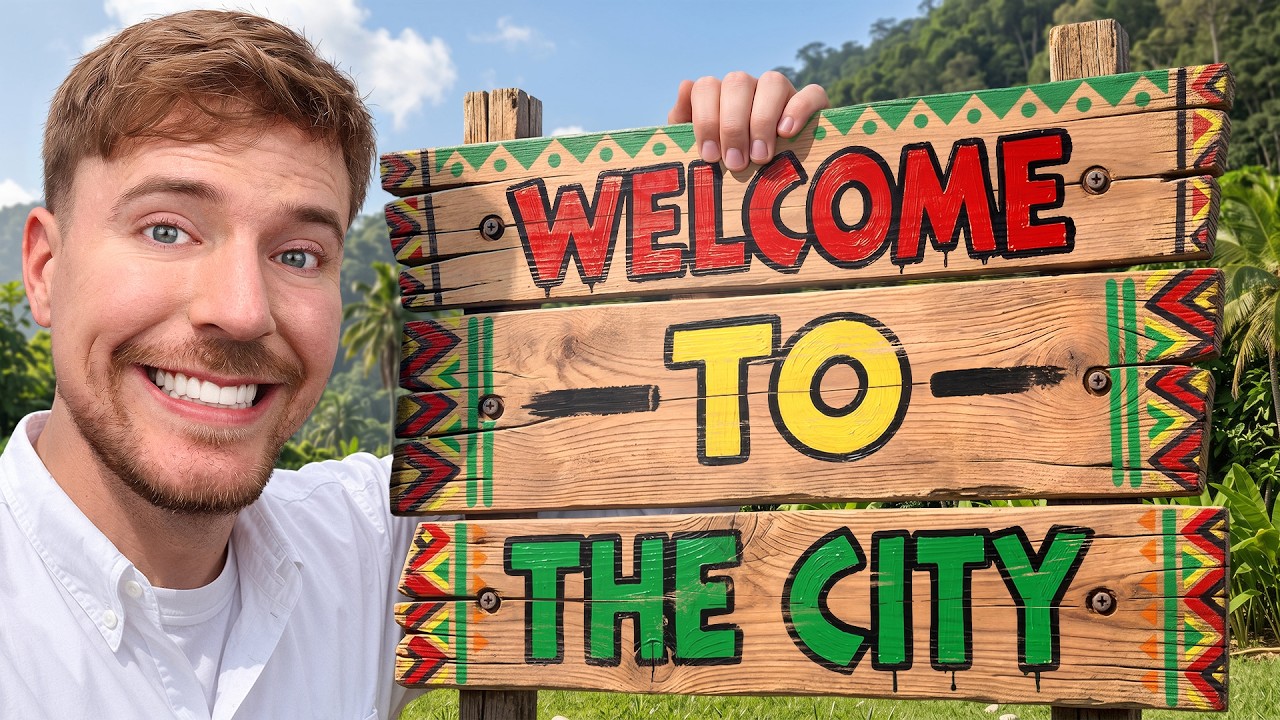
Isaac, a teacher in Ghana, had been sharing two rooms with his wife and three children inside a building he split with roughly a dozen other families. The day he walked into a brand-new home built specifically for him, with white tile floors, a wardrobe, a working shower, and solar panels on the roof, he stood in the bathroom doorway and asked out loud: ‘This MY shower?!’ It took about a year, almost ten million dollars, and hundreds of workers and volunteers to build the place Isaac was now standing in. The field that became that home had been empty dirt when the project began. By the time Isaac moved in, it was a functioning city. MrBeast and Beast Philanthropy does amazing work around this world! Absolutely amazing what was accomplished. See the full video and check out his Beast Philanthropy Channel as well!
From an empty field to Abna Dakwa Village
The goal behind the construction was specific: children in this part of Ghana were trapped in illegal labor on cacao farms, and the most reliable way to get them off those farms was to make school attendance possible and genuinely worth showing up for. That meant the school itself had to exist first. Crews poured 100,000 pounds of concrete just for the school foundation, then raised over a hundred walls across ten brand-new classrooms, each wired with working electricity and fans. The old school serving the area had crammed 325 students into a single building where children traveled miles, sat in sweltering heat, and still could not reliably get there during rainy season, when a narrow three-foot drainage pipe would back up and flood the entire path between the community and the construction site. Two new four-foot drainage channels replaced that pipe after two weeks of work in the rain, and the flooding stopped.
Once the school was finished, the community gathered during a lunch break and handed over a list of everything else the city needed. The construction crew worked through it item by item: a well drilled and connected to solar panels, which pumped water up into two elevated tanks each holding over 10,000 water bottles’ worth of capacity, which then piped clean water into every home’s shower, sink, and toilet around the clock. A football field went in. A farm followed, fenced to protect it from wild animals with roughly a hundred poles, planted with corn, yams, cabbage, peas, beans, and peppers, and stocked with fish tanks whose water, mixed with fish waste, flows through an irrigation pipeline to fertilize the crops. The farm also includes a chicken coop large enough for hundreds of chickens. A marketplace opened on the first day, with vendors already laying out plantain chips, eggs, tomatoes, palm oil, and plantains before the afternoon was over. A library, a medical center, and a community center were completed and opened alongside it. Solar-paneled street lights line the paths between buildings.
The piece that makes school attendance actually stick
MrBeast put it plainly about the feeding program: ‘the data shows if you give a kid a free meal at school, they’re much more likely to attend.’ Every student enrolled will receive a free meal every school day for the next five years, 200 meals per student per year. Higher attendance means fewer hours available for farm labor. That chain is the entire point. The ten homes built for teachers, including Isaac’s, are designed to keep qualified educators on site permanently. Each house is fully owned by its teacher, with no rent and electricity costs covered by solar panels rated to run for 30 years.
A child named Alfred, who had never been on a swing before, designed the school playground from scratch during a planning session, specifying the placement of a merry-go-round on the right side, a swing, and a seesaw. He was the first person to use the swing when the playground opened.
The village was named Abna Dakwa Village by Eric, one of the community members who had been involved in the planning from early in the construction.
Isaac turns the tap on in his own kitchen
Isaac runs his hand under the kitchen tap.
The water runs clear, and the moment holds there, not quite finished yet, in a room where the tile is exactly the shade of white he asked for months earlier with a blindfold on.
The field behind Abna Dakwa Village is still just a field, the same empty ground where all of this started. The school with its ten classrooms is now on one side of it, and 1.5 million children across Ghana and Cote d’Ivoire are still working on cacao farms on the other side of a much larger problem. Isaac knows his shower works. The kids know where the merry-go-round is.