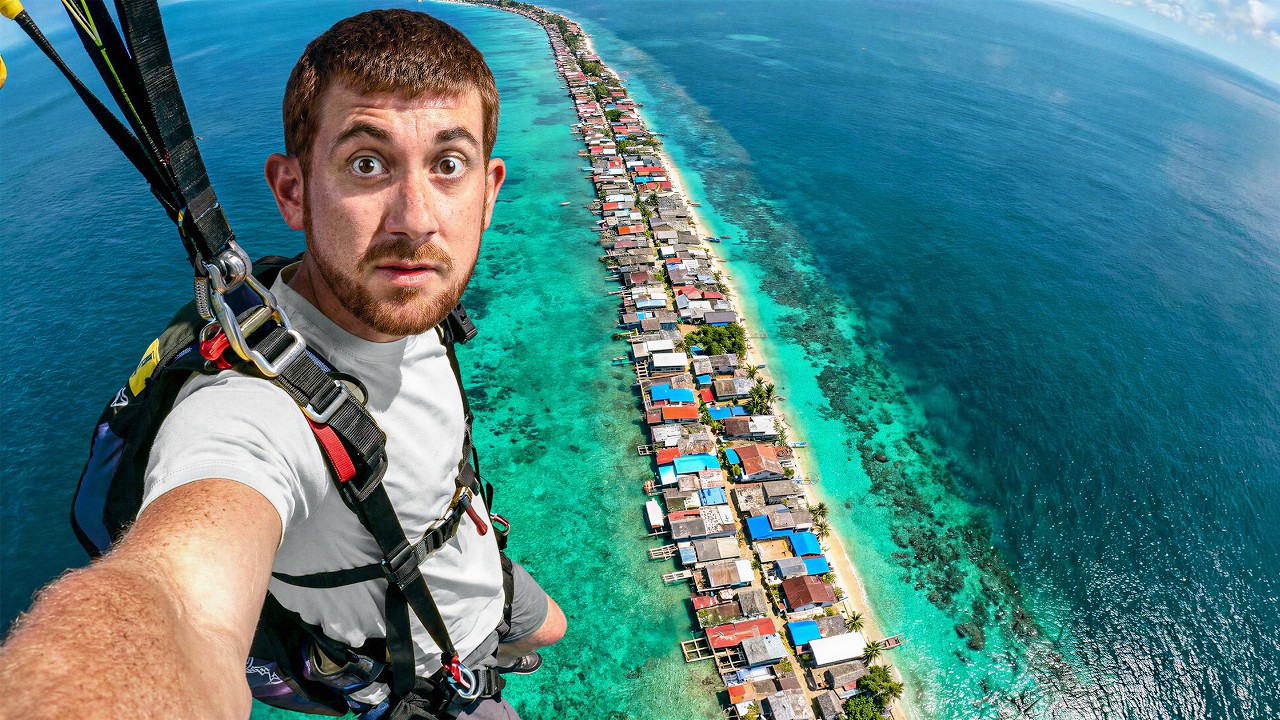
Bilang-Bilangan looks like someone drew a thin pencil line across the surface of the sea. From a boat approaching its shore, the entire island is visible from one side to the other in a single glance, and yet more than 500 people have built their lives on that improbable strip of sand in the Philippines. Travel journalist Drew Binsky arrived unannounced with no translator, no plan, and no idea that by nightfall he would be covered in a full-body rash, lip going numb, on an island with no hospital, no plumbing, and no way out until morning.
The first person to greet Binsky when he stepped ashore was Reggie, a 32-year-old who had spent his entire life on the island and immediately volunteered to show two strangers around. Reggie speaks enough English to hold a real conversation, and within minutes he was pointing out neighbors by name, introducing kids who materialized from every direction, and cheerfully identifying the island’s only known troublemaker as himself.
Where the sand is the road and fish is the economy
Walking the length of Bilang-Bilangan takes almost no time. The roads are sand. There are no cars, only motorbikes, bicycles, and a lot of chickens. The shoreline on one side is close enough to the shoreline on the other that a volleyball net stretched between them actually works, and Binsky and the locals played a match with the ocean at their feet on both ends. At the far tip of the island, two ocean currents visibly collide, the water swirling in opposite directions where the sea meets itself.
Food comes almost entirely from those waters. Fish dry in rows along the shore. Chicken isaw, smoked intestine skewers served with dipping sauce, is a local staple that Binsky called ‘really, really good’ after initially hesitating at the description. A meal of pancit noodles and chorizo appears from a neighbor’s kitchen without ceremony. Six-peso cups of three-in-one coffee, ground beans and sugar in a bag with hot water, come from the sari-sari store, a corner shop with chips hanging from the ceiling and single-use sachets of soap and toothpaste sold one at a time because most families cannot afford a whole bottle.
The island has solar panels but no central electricity grid. It has no hospital. The nearest medical care is in Bien Unido, a town reachable only by boat. Cebu City, with its proper hospitals, is considered too far and too expensive for most residents to consider. Water arrives in two-peso plastic bags. Internet, though, is available through peso-operated wifi terminals: five pesos buys three hours and thirty minutes of connection, which is how Binsky ended up uploading a photo of his rash to ChatGPT at midnight trying to figure out what was happening to his body.
Spearfishing after dark and a jellyfish that had other plans
Reggie had promised an evening of spearfishing, and after sunset the two of them paddled out well past the shoreline with a rubber-band speargun, a single homemade fin Reggie wore on one foot, and a flashlight. Reggie pulled sea cucumbers, sea urchins, and fish from the dark water with a calm efficiency that made it look easy. Binsky dangled his feet off the side of the boat and watched.
By the time they returned to shore, something was clearly wrong. A red rash had spread across Binsky’s chest and back. His lip was going numb. His big toe was swollen and puffy in a way that suggested something had stung it while his feet hung in the water. Reggie’s aunt, who the transcript refers to as Tita, took one look at him on the beach and brought him inside. She poured vinegar over his skin, which Binsky described as feeling like ‘little pieces of knives going in.’ Then she made him ramen, gave him a bed, and sat with him while the Benadryl he had picked up at a Walgreens before leaving home began to do its work.
A bed in a house that survived Typhoon Odette
Tita’s house is spacious by island standards, airy and well-kept. A large tree came down on it during Typhoon Odette four years ago. The tree is still there, absorbed now into the shape of the backyard. The roof was destroyed in that storm and had to be rebuilt. Water reached stomach height inside the house. This is not an unusual story on Bilang-Bilangan or across much of the Philippines, where tens of millions of people face flooding with nowhere higher to go.
Binsky spent the night in that house. By morning the rash had not worsened and the numbing had eased. He said he would probably never know the exact cause with certainty, his best guess being some kind of jellyfish contact, but that the kindness of the family around him made the fear manageable in a way it would not have been anywhere else.
Tita’s kitchen, where a fallen tree once crashed through the ceiling, is still standing. The vinegar bottle she used is somewhere inside it.