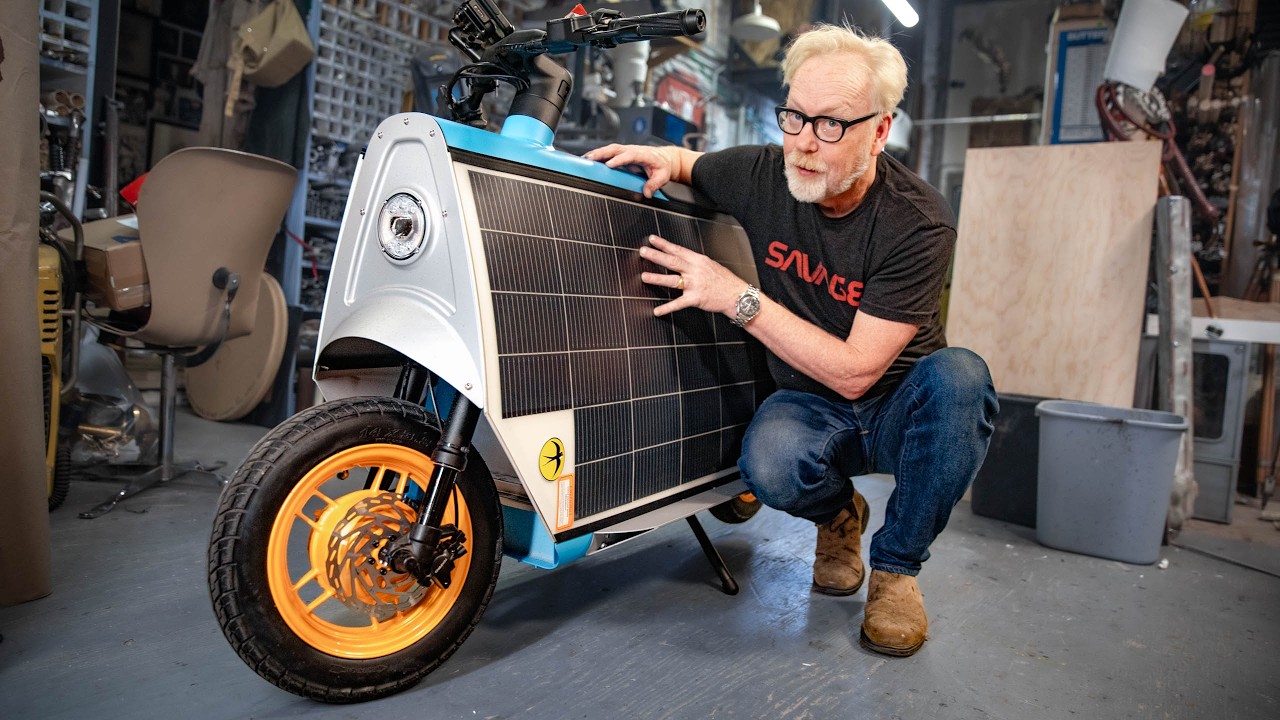
Adam Savage was halfway through unpacking a cardboard pallet when he stopped and just stared. The machine sitting in his San Francisco shop was, by any reasonable visual measure, a kid’s drawing of a future vehicle brought to life: two wide wheels, a low-slung seat, and a pair of solar panels draped across the top like a portable roof. It looked simultaneously ridiculous and inevitable. For anyone who has spent decades caring about how objects communicate their purpose, the Lightfoot sun-powered cargo scooter from Other Labs landed less like a product and more like a provocation.
What it actually is and what it actually does
Other Labs, a San Francisco and Australia-based company of invention, built the first batch of these scooters themselves, without outside investment and without private equity backing. Saul Griffith, the company’s founder, lent Savage the unit he spent the weekend testing. The specs are straightforward: a 1.1 kilowatt-hour battery, a 600-watt onboard charger, a stated range of roughly 35 miles, and a charge to 80% battery in 90 minutes when plugged into the wall. The solar panels, approximately 45 watts each, add between 8 and 18 miles of extra range per day simply from sitting outside in daylight.
The construction is almost entirely bent and welded sheet metal and tubing, a deliberate choice for simplicity and to keep the cost of the vehicle accessible. Storage is built into the body rather than bolted to the outside: 41 liters of lockable interior space, which Savage described as ‘a legit amount.’ The scooter accommodates riders between 5-foot-3 and 6-foot-6, operates legally in bike lanes, and can be secured with a standard Kryptonite lock on the wheel in addition to its built-in password protection.
Savage put 50 miles on the scooter over a single weekend. He rode side streets and empty neighborhoods, sought out views, and spent a full hour covering 15 miles in heavy San Francisco traffic specifically to test how the machine felt under pressure. ‘You feel substantial. You feel visible,’ he said of riding it in dense traffic. The center of gravity sits low enough that signaling by hand and checking over a shoulder produced no unexpected shifts underneath him. The riding position reminded him of an old cafe racer or a Lambretta.
The argument the scooter is actually making
Savage was transparent about why he agreed to cover this at all. ‘I believe in the mission,’ he said plainly. ‘I don’t have a financial arrangement.’ The Lightfoot is not a commuter motorcycle, not a cargo bike, and not a conventional electric scooter. It carries no pedals. It does carry a visible, almost cartoonish commitment to passive solar energy, which is precisely the point Griffith and his team seem to be making. As Savage framed it, the scooter functions as a physical metaphor for grabbing energy from photons and turning them into fuel, without apology and without the subtlety that usually smooths a new technology into market acceptance.
Every time Savage parked to run an errand, he returned to find strangers gathered around it mid-conversation. That alone, he argued, is a kind of public service.
The 41 liters of lockable cargo space
The interior storage compartment, integral to the body rather than attached to it, holds a laptop or a week of groceries without advertising its presence to anyone walking past. For a machine that draws this much attention on its own, that restraint is its own design statement.
Savage’s wife, when he showed her a photo before the scooter arrived, said flatly: ‘I’m not getting on that. That’s ridiculous.’ She had plenty of company. Online comment sections, he noted, split cleanly between people who immediately understood the vehicle and people who called it the dumbest thing they had ever seen. The critics are not entirely wrong on the engineering merits, and Savage acknowledged as much. The solar panels operate below their maximum efficiency in real-world conditions. This is version 1.0. Every version 1.0 changes radically by the time it reaches its second and third iteration, and this one will too.
What it is right now, in this first run of a thousand units built without outside money, is the thing on the box: a smile machine.