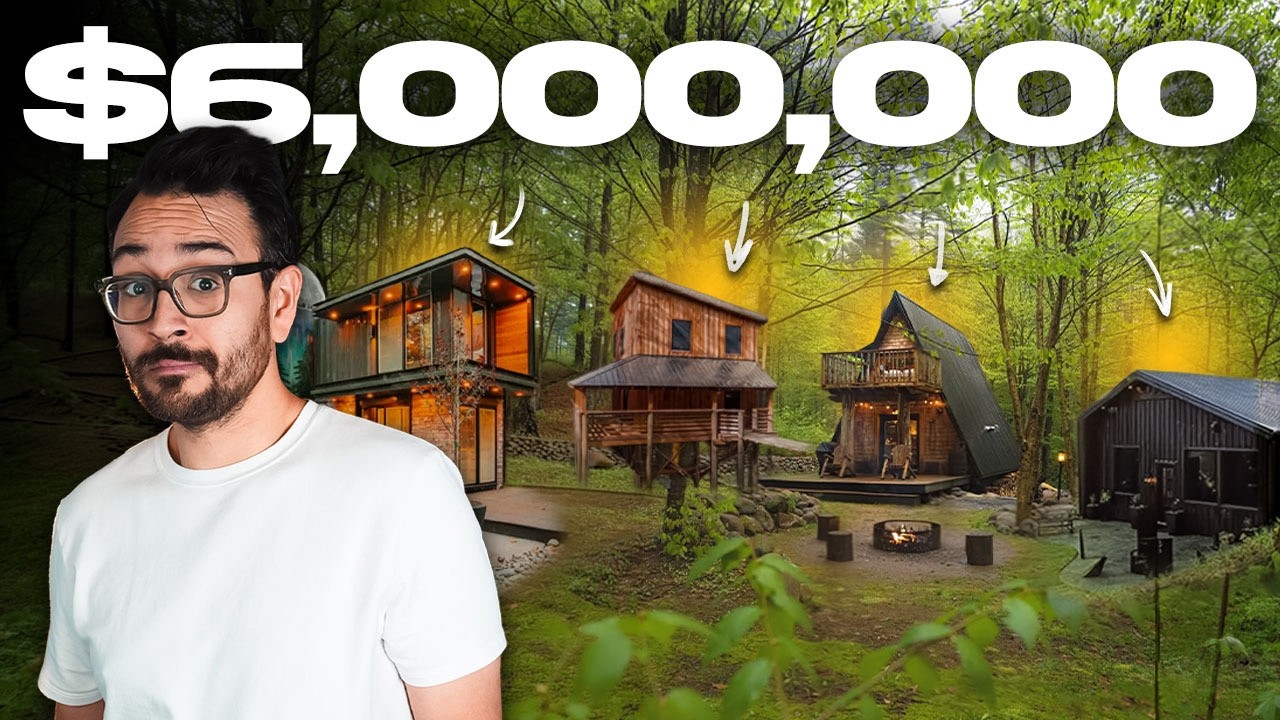
Chris Broomfield spent 35 years building custom homes with million-dollar views and handcrafted details in Connecticut, and not one of them was his. For anyone who has ever traded their best skill for someone else’s dream, that gap between the work you do and the wealth it never builds is a specific, quiet kind of ache. Chris felt it long enough that he finally did something about it: he bought five acres of wooded land in Remson, New York, a town of roughly 3,000 people on the edge of the Adirondacks, for $27,000, and built a single A-frame cabin with no investors and no real estate background to speak of.
The cabin that started at sixty dollars a night
The build cost Chris about $90,000 all in, roughly half what a hired crew would have charged. ‘I’m cheap,’ he said. ‘I didn’t have the money to spend at the time. I had the skills. I had the time.’ He listed it on Airbnb in July 2015, priced at $60 a night, mostly hoping someone would show up. In the first six months, the cabin brought in about $7,000. He nudged the rate up gradually: $70, then $80, then $100 a night. By year two, gross revenue hit $70,000. By year three, it was clearing $100,000 to $115,000 annually on a $90,000 build, a cash-on-cash return of roughly 94 percent, against a benchmark of 8 to 12 percent in traditional real estate.
The feature that put Evergreen Cabins on the map was born from a compromise with his wife. Chris loves sleeping outside in the cold; she does not camp. His solution was a bed with a button: press it, and the entire room slides outdoors, placing guests under open sky. That single design detail caught the Airbnb algorithm’s attention and started filling his calendar before he even understood how to add a link to his Instagram posts.
When the bookings kept coming, he built a second cabin, this one shaped by his kids, who asked for a treehouse connected to the opposite side of a ravine by a cable bridge. It went up in 13 weeks, cost $175,000, and opened at $400 to $450 a night. Then a guest posted a TikTok that hit 7 million views in a week. ‘My phone blew up,’ Chris recalled. ‘Every single date for both cabins were booked solid for 3 years.’ He did not raise his rates when the flood hit, a mistake he later estimated cost him hundreds of thousands of dollars in foregone revenue across three years of locked-in old pricing.
Five units, one piece of land, and a brand worth millions
Rather than slow down, he kept building. The third cabin, Birch Falls, solved a winter problem: the property’s natural waterfalls were freezing and tearing infrastructure apart, so Chris put the waterfall inside, building an interior cascade with spa amenities for $165,000. A container cabin followed, its walls framed with his daughter’s hand-drawn cabin sketches, the sliding bed from the original A-frame brought back, and a hand-painted silo with a sky bubble alongside it. Finally, he built himself a small place to stay on his own property. Total land cost across all five units: that original $27,000.
The 2026 projected gross revenue across the five units breaks down as follows: the A-frame is projected at $150,000 to $155,000; the treehouse at $160,000 to $165,000; Birch Falls at $145,000 to $150,000; the container cabin, which launched only four months ago, is already tracking toward $170,000 to $180,000; and his own tiny house, which he barely markets, is on pace for $60,000 to $70,000. Combined, the portfolio is projected to generate approximately $680,000 in gross revenue. After a monthly overhead of about $21,000, covering mortgage payments, taxes, utilities, insurance, full-time cleaners, and maintenance, the estimated annual net profit lands around $430,000.
Ninety percent of bookings now come directly, bypassing platform fees entirely. Chris has built an email list of 60,000 people and 160,000 Instagram followers. He values the entire operation at $5.5 million to $6 million, and his next move is to find a second property in a different region to replicate the brand before eventually selling it. He quit carpentry. ‘Now I just run Evergreen and do consulting and spend a lot of time with my family and vacations,’ he said.
The sliding bed, still waiting for someone to press the button
In the original A-frame, the bed with the button that slides the room outside sits ready, the same feature that started everything.
Chris Broomfield spent 35 years building other people’s dream homes before buying five wooded acres in a town most people have never heard of for $27,000. The A-frame he built there for his family, the one that started at $60 a night on a quiet Airbnb listing, now projects more than $150,000 in gross revenue for 2026 alone. ‘Be authentic,’ he offered when asked what he would tell someone starting out. ‘Build something that you would enjoy, not what makes sense financially. It’s that whole if you build it, they will come.’