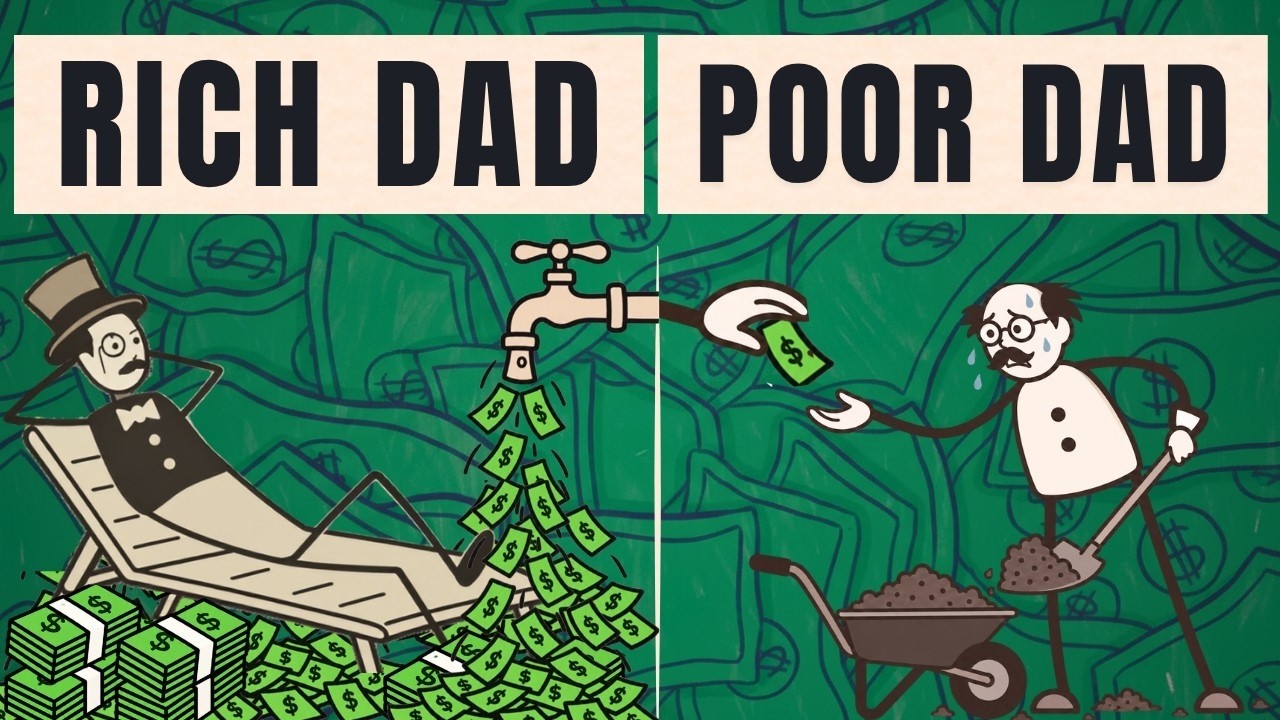
At nine years old, the narrator of this journey cried for an entire week until his parents gave in and bought him a secondhand bike. They could not quite afford it, and they were too proud to say so. What happened next was not planned: he turned out to be the only kid on the block with a bike, and every other child started handing over coins just to take it for a spin. Without knowing the word for it, he had stumbled onto one of the core ideas in Robert Kiyosaki’s Rich Dad Poor Dad: the difference between an asset and a liability comes down to a single question. Does it put money in your pocket or take money out?
The lesson the scratched-up bike taught first
Rich Dad Poor Dad opens not with spreadsheets but with a kid who spots dirty cars on his street and knocks on 20 doors. Seven people say yes to a wash. The catch: he owns no bucket and has no money to buy one. So he collects half the payment up front from each customer, walks to the store, buys the supplies, hires a few friends to do the actual washing, and keeps the back half of every payment as pure profit. His customers funded his equipment. His friends supplied the labor. He spent none of his own money.
The point Kiyosaki builds from that story is sharp: it is not money that makes money, it is financial intelligence. As the narrator puts it, ‘If you can’t see money with your mind, you will never hold it with your hand.’ The mental shift is replacing ‘I can’t afford it’ with ‘How can I afford it?’ The first statement freezes the brain. The second forces it to start connecting dots.
The bike story lands the same principle at a personal scale. A secondhand bicycle ridden only for fun is a liability, money flows out to repairs and storage. The moment it is rented to the neighborhood kids, coin after coin, it becomes an asset. Rich Dad’s formula from there is almost aggressively simple: buy more assets, let those assets buy the shiny things later, and ask before every purchase which pocket the money is actually flowing into.
The pyramid parable and the danger of lifting stones forever
To explain why systems beat raw effort, the source offers a parable about two nephews ordered by a pharaoh to build two pyramids. Azer starts hauling heavy stones immediately. Chuma spends three years building a machine of ropes, wheels, and levers. Azer, watching Chuma tinker in a barn, calls him lazy. Three years later, Chuma’s machine builds in one week what Azer spent a year constructing by hand. Chuma finishes his pyramid in eight years total. Azer, still hauling stones two levels from the top, has a heart attack and dies. The narrator’s frame is precise: ‘Azer worked for money. Chuma made money work for him.’
The parable maps onto what Kiyosaki calls the rat race: fear of being broke drives people to a job, the paycheck arrives, greed kicks in, the money disappears on upgrades and lifestyle, and the fear returns. Work, earn, spend, panic, repeat. The exit is not working harder inside the loop. It is building the machine that runs without you.
When debt became the most dangerous lesson
In 2015, fresh from reading Rich Dad Poor Dad, the narrator bought a three-room apartment just outside the city center for $60,000. He put down $18,000, which was everything he had, rented the apartment out instead of moving in, and watched the rent cover the mortgage. When prices climbed, he was not earning a return on $18,000. He was earning a return on the full $60,000 the bank had financed. By 2019 the apartment had doubled in value. Rather than selling, he used the equity built inside that first property as collateral to finance a second purchase without a new down payment and without a taxable sale. Fast forward to September 2026: both apartments sit at roughly $150,000 each, and the same mechanism is being used to finance a $500,000 property with no new cash from his own pocket. The original $18,000 from 2015 is the only money that ever entered the system.
He does not dress this up. ‘I got lucky. Very lucky. If prices had dropped instead, that $18,000 would be gone, and I’d still owe the bank every month.’ Leverage and debt, in his framing, are like fire: controlled, they cook your food; careless, they burn the house down.
Kiyosaki’s definition of wealth reframes the entire conversation. Wealth is not a dollar figure or a property value. It is the number of days you can survive without working. A person earning $20,000 a month who also spends $20,000 a month survives perhaps two weeks if the income stops. A person on a modest salary whose rental flat and side income cover the monthly bills keeps going indefinitely. Everyone at the barbecue thinks the first person is rich. Everyone at the barbecue is wrong.
The eighth lesson, on selling, is the one the narrator says has made him the most money personally. He watched genuinely strong content die on lazy titles and thumbnails. As he puts it: ‘YouTube is not a watch platform. It is a click and watch platform. And the click is the sale.’ Kiyosaki himself leans into the same idea, describing himself not as a best-writing author but a bestselling one. Plenty of people write better. He simply learned to sell better than all of them.
The $18,000 that never left the system
Somewhere in a city not named in the telling, two apartments bought years apart are now doing the quiet work of financing a half-million-dollar property. No new cash changed hands. The value that accumulated inside the first two properties is the collateral, and the original down payment from a decade ago is still the only personal money in the machine.
Fail often enough, Kiyosaki’s tenth lesson argues, and the GPS does not declare the trip ruined. It recalculates from wherever you stopped and offers a new route. The people who avoid the wrong turns, he says, also avoid the destination. Four videos with zero traction is not a verdict. It is a missed turn. The route continues from there.