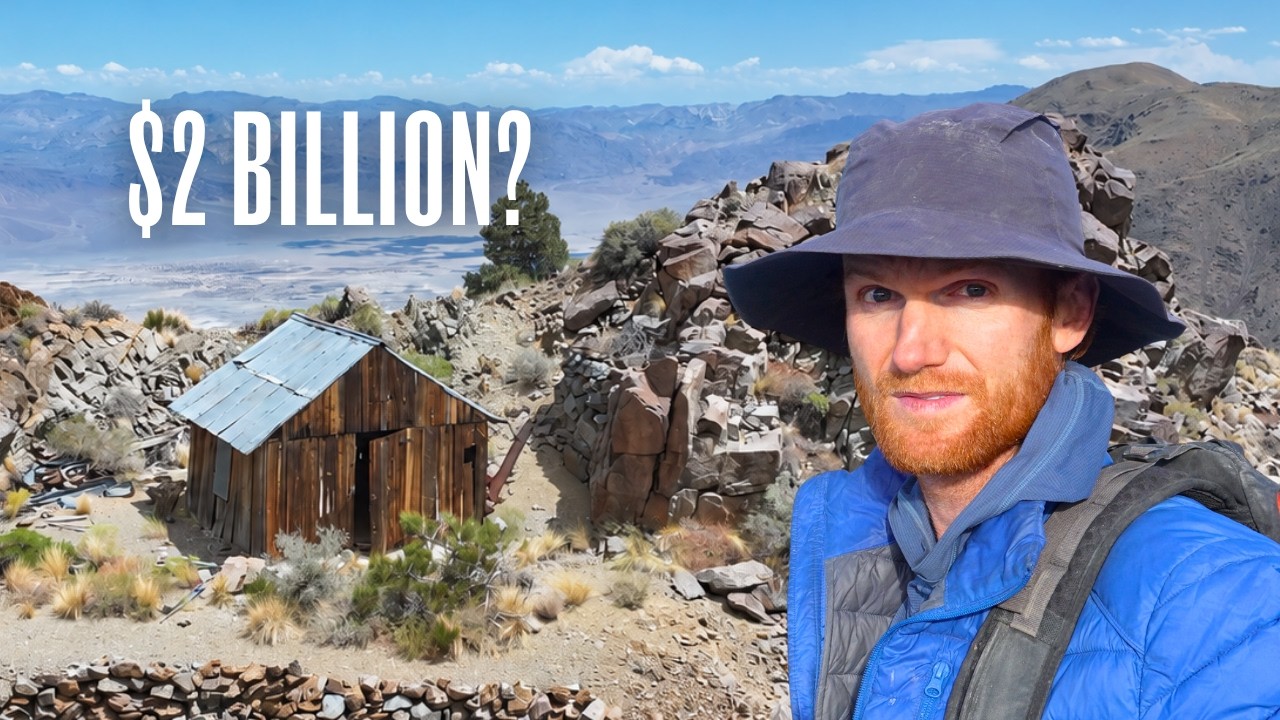
The quartz vein is still there, white and wide inside the dark of the Big Horn Mine, running an estimated 2,000 feet through the Inyo Mountains of California. Brent, the caretaker of the abandoned silver town of Cerro Gordo, had just hiked 18 hours through one of the most unforgiving mountain ranges in the country to stand in front of it. The draw was simple and staggering: a 1985 Bureau of Mines report, based on 77 chip samples, inferred 1.2 million tons of ore running an average of 4 ounces of gold per ton and 2.5 ounces of silver per ton, which at today’s prices puts the still-unmined value at over $2 billion. None of it will ever come out. The area is now designated wilderness.
A canyon the sun reaches for one hour a day
The Beverage Mining District sits on the eastern flank of the Inyo Mountains, a range so steep and dry that the sun only reaches the canyon floor for roughly an hour each day. The Sierra Nevada on the opposite side absorbs the Pacific moisture and draws tourists; the Inyo side gets neither. What it got instead, starting in 1877, was a man named William Hunter, a Virginia-born Confederate Army veteran who had slowly worked his way west and eventually staked a claim at a quartz vein on a remote spine of rock above Saline Valley. He called the district after his partner, John Beverage, an attorney and twice-elected but never-qualified district attorney of Inyo County who died in October 1874. Beverage’s funeral at Cerro Gordo was reportedly one of the most attended the town ever held.
By the time mining slowed in the 1920s and 1930s, the Big Horn had produced roughly 1,600 ounces of gold and 9,600 ounces of silver, worth about $7.5 million at today’s prices. The Beverage Mining District as a whole pulled close to 38,000 ounces of gold from those near-inaccessible canyons. Three steam-powered arrastras worked the ore in the earliest years, with a shaft already driven 170 feet by 1880. The hoist system that remains on site is a Davis Hoister, patented December 11, 1888, built by a Lancaster, Pennsylvania forge company. The mechanism beside it appears to be a horse whim: a circular track where a horse would walk in a loop, turning a cable drum that pulled ore buckets up from below. The device is still standing.
A helicopter crash nobody recorded
By the 1970s, the owners of Cerro Gordo had gained control of the Big Horn and were trying to market it for sale. They hired two local men, Dan Dickman and Allan Atkin, as packers to bring in prospective buyers by mule. A geologist was brought in to take samples, accessing the site by helicopter. One day, while the pilot hovered near the cabin to collect the geologist and his samples, the rotor blade clipped a rock. The helicopter went down. The geologist died. The pilot, injured but alive, spent the night sliding down the waterfalls of Hunter Canyon to reach Saline Valley. Dan Dickman picked him up in his truck. Racing for the hospital in Lone Pine, they blew a tire. Allan later described watching the pilot physically shrink with each new delay. They swapped the spare and kept moving. A CB radio relay through a man permanently camped at a nearby hot spring reached a woman in Lone Pine whose handle was ‘Caboose.’ By the time the truck reached Lone Pine Flats, military helicopters, police cars, and emergency crews were waiting. They took the pilot and, as Allan put it, ‘vanished into the sunset.’ The story never made the newspapers. Brent found a piece of the wreckage near the cabin: a curved metal wing panel still marked ‘Bell Helicopter Company.’
Brent had first heard the word ‘Beverage’ from a late mentor named Tip, who told him near the end of his life that he really needed to explore the district. Standing inside the mine, Brent drew the line quietly: ‘Hunter named this area after his late friend, and I first heard about it from my late friend.’ The Beverage Mining District produced $170 million worth of gold. The man it was named after has been largely forgotten. Hunter himself died in 1902, but the chain of memory stayed short enough that Dan Dickman, who hauled mules into the Big Horn half a century ago, personally knew Hunter’s son.
What the vein looked like in 1880
A visitor who recorded his observations in 1880 described the quartz vein as 2 to 5 feet wide and running more than 2,000 feet. The ore visible on the ground and inside the shaft was running a cumulative 4 ounces of gold per ton alongside 2.5 ounces of silver. Some high-grade pockets reportedly pushed toward the same range in concentrated bursts. The wall of white quartz inside the mine is still present, still unblasted.
‘How much would it cost you to get it out of here?’ Brent said, looking at the vein. ‘The age-old question with a mine.’
After 18 hours of hiking, he sat in the cabin for a while before starting the climb back up to 10,000 feet.
The boots left in the cabin
A pair of old boots sits on the floor of the Big Horn cabin, likely left from the era when Dan and Allan packed mules into the canyon. They are still there.